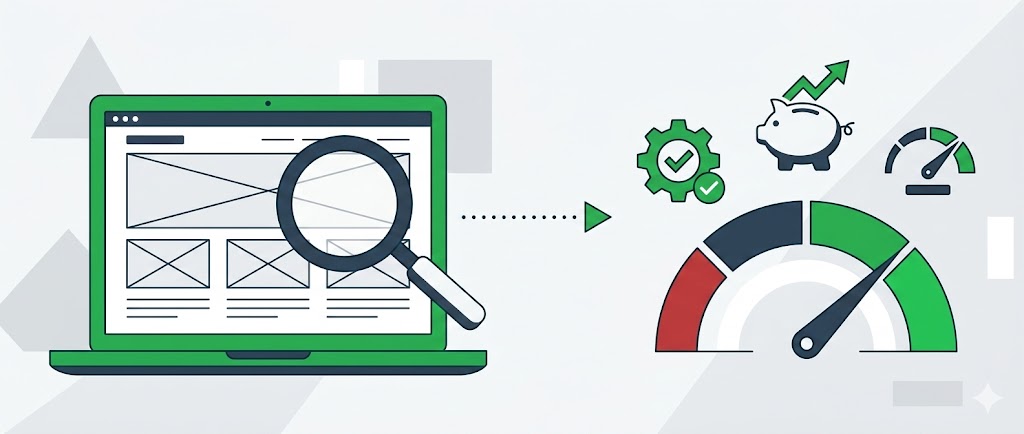
Last month, a café owner in Barnstaple called me in desperation. Her website was taking nearly 8 seconds to load, and she'd watched potential customers literally walk away whilst waiting for her menu to appear on their phones. She wasn't imagining it — she was losing real money to a problem that cost less than £50 to fix.
Website speed isn't just about user experience anymore. It's about survival. Google's algorithm heavily favours fast sites, and UK consumers have zero patience for slow-loading pages. I've been building websites since the mid-1980s, and I can tell you that speed has never mattered more than it does right now.
47% of visitors expect a page to load in 2 seconds or less
And 40% will abandon a site that takes more than 3 seconds to load — that's nearly half your potential customers gone before they've even seen what you offer.
The Real Cost of a Slow Website
Here's what actually happens when your website crawls along like a tractor on the A39. Every extra second of load time reduces conversions by roughly 7%. For a small business turning over £100,000 annually through their website, that's potentially £7,000 lost per year for every additional second.
I recently worked with a plumber in Taunton whose website took 6 seconds to load on mobile. He was getting plenty of clicks from Google Ads but hardly any phone calls. Within a week of fixing his speed issues, his conversion rate doubled. Same traffic, twice the business.
Google's mobile-first reality: Since 2021, Google primarily uses the mobile version of your site for ranking. If it's slow on mobile, you're invisible in search results where it matters most.
Diagnosing Your Speed Problems
Before you can fix anything, you need to know what's broken. Don't guess — measure. I use three tools religiously, and they're all free:
Google PageSpeed Insights
This should be your first stop. It gives you separate scores for mobile and desktop, plus specific recommendations. Anything below 90 needs attention, and below 50 is an emergency.
GTmetrix
Provides more detailed waterfall charts showing exactly which elements are slowing you down. The free version gives you enough data to identify the biggest culprits.
Pingdom Website Speed Test
Choose the London server for UK-relevant results. This tool excels at showing you the size and load time of individual page elements.
Run these tests from different locations if possible. A site that loads quickly in London might crawl in rural Devon due to varying internet infrastructure.
The Big Three Speed Killers
In my experience, three issues cause 80% of website speed problems for UK small businesses. Fix these first before worrying about anything else.
Oversized Images
This is the big one. I regularly see websites trying to load 5MB photos straight from someone's iPhone. A B&B owner in Exmoor recently had 20 unoptimised photos on her homepage — each one larger than most people's entire websites should be.
The fix is straightforward: resize images to the maximum size they'll actually display, then compress them. For most website photos, 150KB should be your upper limit. Tools like TinyPNG or Squoosh.app can reduce file sizes by 70-80% without visible quality loss.
Poor Web Hosting
That £3-per-month shared hosting deal isn't doing you any favours. Cheap hosting providers often cram hundreds of websites onto servers that can barely cope. The result? Your site loads like treacle, especially during peak hours.
You don't need to spend a fortune, but budget at least £10-15 monthly for decent hosting. I've had excellent results with providers like SiteGround and WP Engine for WordPress sites. The performance difference is night and day.
Plugin and Code Bloat
WordPress sites are particularly vulnerable to this. Every plugin adds code, and many are poorly written. I've seen sites with 40+ plugins wondering why they're slow. One local restaurant had three different contact form plugins running simultaneously — none of them actually working properly.
The 10-plugin rule: If your WordPress site has more than 10 active plugins, start deactivating ones you don't absolutely need. Your site will thank you.
Quick Wins You Can Implement Today
You don't need a computer science degree to make meaningful speed improvements. Here are five changes you can make this afternoon:
- Install a caching plugin — WP Rocket or W3 Total Cache for WordPress sites. This alone can halve your load times.
- Enable GZIP compression — Most hosting providers offer this in their control panels. It compresses your files before sending them to visitors.
- Remove unused plugins and themes — Don't just deactivate them, delete them entirely.
- Optimise your database — WP-Optimize plugin can clean out accumulated junk automatically.
- Use a Content Delivery Network (CDN) — Cloudflare's free tier is perfectly adequate for most small businesses.
When to Call in Professional Help
Some speed issues require technical expertise to resolve properly. If your site is still slow after tackling the basics, or if you're seeing complex server-level problems, it's worth investing in professional help.
A good web developer can implement advanced optimisations like lazy loading, critical CSS, and database query optimisation. These techniques can shave precious seconds off load times, but they require careful implementation to avoid breaking functionality.
ROI reality check: Professional speed optimisation typically costs £300-800 but can increase conversions by 15-30%. For most small businesses, that pays for itself within months.
Website speed isn't a luxury — it's a business necessity. Every day your site loads slowly is another day you're handing customers to faster competitors. Start with the basics: optimise your images, upgrade your hosting, and clean up your plugins. These simple changes can transform a sluggish site into a conversion machine.
The café owner I mentioned earlier? Her 8-second load time dropped to 1.8 seconds after optimising images and switching hosting providers. Her online orders increased by 60% within a month. That's the power of a fast website — and it's within reach of every small business willing to make the effort.
Sources
- Think with Google — Mobile page speed research and statistics
- Google PageSpeed Insights — Free website speed testing tool
- HubSpot — Research on page load time impact on conversion rates
Need Help With Your Website?
Whether you need a new website, a redesign, or help with SEO — I'd love to have a chat about how Exmoorweb can help your business grow online.
Get In TouchNo obligation. No sales pitch. Just honest advice.
About the Author: Marcus Knapman has been designing websites since the mid-1980s. He runs Exmoorweb from Devon, helping small businesses across the South West and beyond build their online presence. With a BSc (Hons) and over 40 years of hands-on experience, he combines technical expertise with practical business sense.