Picture this: A potential client lands on your About page. They scroll past the generic "Founded in 2015" paragraph. Their eyes glaze over at the wall of text describing your achievements. They leave without remembering a single detail about your company's journey. Sound familiar?
Here's the hard truth: Nobody reads company histories anymore. Not the way they're typically presented. Dense paragraphs about founding dates and expansion milestones? They blend into the background noise of every other corporate website. But here's the opportunity: When you transform that same story into a visual timeline with smooth animations and clear milestones, suddenly people pay attention. They scroll. They engage. They remember.
Why Traditional Company Histories Fail to Connect
Your company's journey is probably fascinating. You've overcome challenges, hit major milestones, and built something worth celebrating. So why doesn't your About page communicate that excitement? Let's break down where traditional company history sections fall short:
1. Text Walls Are Invisible to Modern Readers
Online readers don't read—they scan. Research shows that 79% of web users scan rather than read word-for-word. When your company history is presented as paragraphs of continuous text, visitors skip right over it. Their brains categorize it as "corporate filler" and move on.
2. Chronology Gets Lost in Narrative
When you describe your journey in paragraph form, the timeline becomes muddy. Was the expansion before or after the award? When exactly did you hit that major milestone? Readers have to work to piece together the sequence of events. And if they have to work, they won't bother.
3. Achievements Lack Visual Hierarchy
Not all milestones are equal. Launching your company is more significant than updating your logo. But in a text paragraph, everything gets equal visual weight. The truly impressive accomplishments get buried among minor updates, diluting their impact.
4. There's No Engagement, Just Passive Reading
Static text doesn't invite interaction. Visitors land on your About page, scroll once, and that's it. There's nothing drawing their eye down the page, no visual journey to follow, no reason to pause and engage with each milestone.
Real-World Impact: A professional services firm replaced their text-heavy company history with an animated timeline section. Average time on their About page increased from 22 seconds to 1 minute 47 seconds—a 385% increase. More critically, contact form submissions from visitors who viewed the timeline increased by 63%. Why? Because people finally understood and connected with their journey.
How Animated Timelines Transform Storytelling
An animated timeline section isn't just about making things prettier—it's about strategic communication design that guides attention, creates engagement, and makes your story genuinely memorable.
1. Visual Chronology That Reads Like a Journey
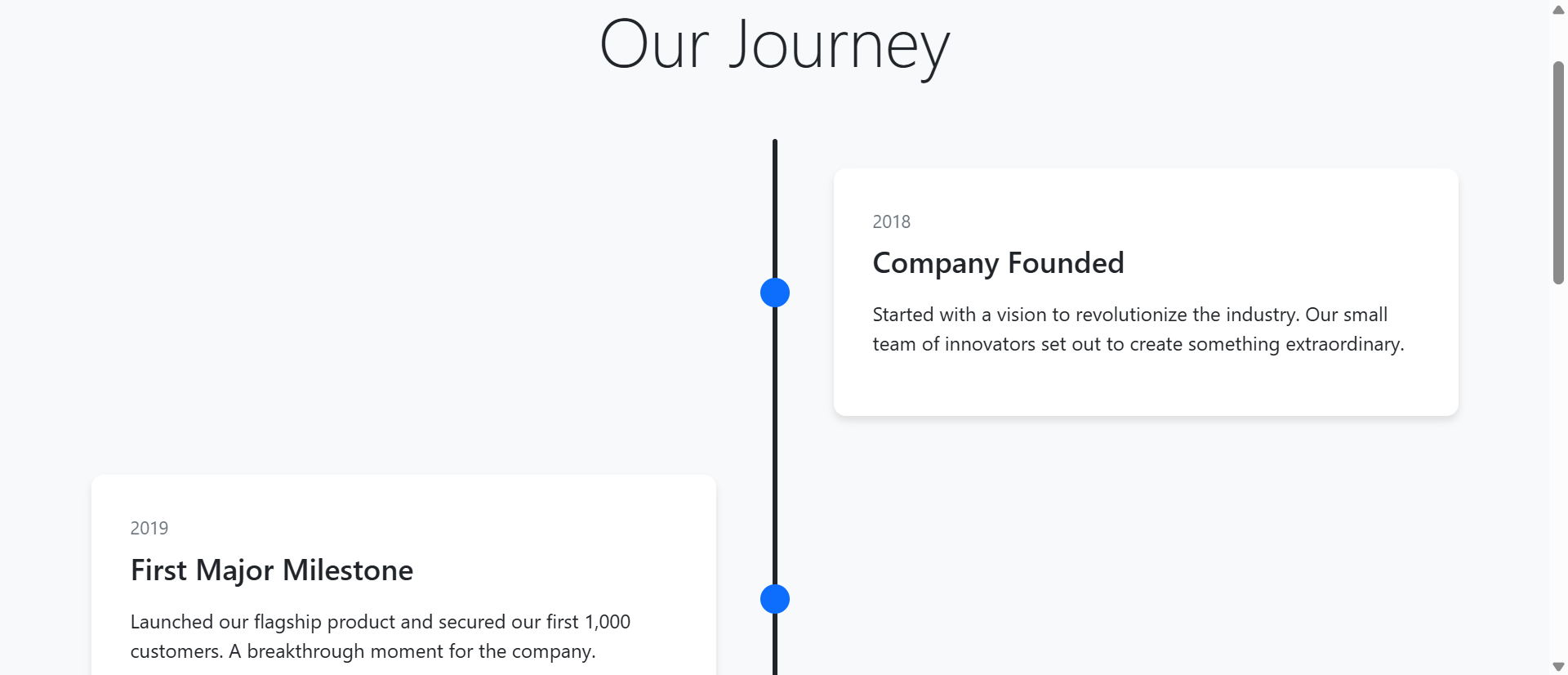
The vertical timeline with a central line creates an instant visual metaphor: this is a journey through time. Your eye naturally follows the path from top to bottom, from past to present. Each milestone is a stop on that journey, clearly separated and easy to digest.
The alternating left-right pattern (zigzag layout) prevents monotony. Your eye moves down, left, down, right—creating a natural scanning rhythm that keeps you engaged. Compare this to a paragraph where your eye just moves straight down in a single column. The timeline's zigzag pattern is inherently more dynamic and interesting.
2. Staggered Animations That Guide Attention
Here's where the magic happens: When you scroll to the timeline section, milestones don't just appear all at once. They fade in progressively with subtle upward motion. First milestone animates in. Then the second. Then the third. This staggered animation does something powerful—it controls the pace at which visitors consume your story.
Instead of overwhelming them with your entire history at once, the animations reveal your journey piece by piece. Each milestone gets its moment in the spotlight. This progressive disclosure matches how humans naturally process narratives: beginning, middle, end, in sequence.
3. Hover Interactions That Invite Exploration
When visitors hover over a timeline dot, it grows and glows with a subtle pulsing effect. This micro-interaction serves two purposes: First, it provides immediate tactile feedback—the page is responding to them. Second, it encourages exploration. Visitors instinctively move their mouse down the timeline, hovering over each milestone, which means they're actually paying attention to each one.
These tiny interactive moments transform passive scrolling into active engagement. And active engagement means deeper connection with your story.
4. White Space That Creates Breathing Room
Each milestone sits in its own contained card with generous padding and white space. This isn't just aesthetic—it's cognitive design. The white space gives your brain room to process each milestone before moving to the next. It prevents the overwhelming feeling you get from dense text blocks.
The visual separation makes it easy to skim and digest. Visitors can quickly scan the dates and titles to get the overview, then dive into specific milestones that interest them. It's flexible consumption, designed for how people actually browse websites.
Pro Tip: The timeline doesn't have to be comprehensive. Include 5-7 truly significant milestones rather than trying to document every minor event. Each entry should represent something genuinely impressive or transformative. Quality over quantity creates stronger impact.
Real-World Applications Across Industries
The animated timeline isn't limited to tech startups showing their growth trajectory. Here's how different types of businesses leverage it effectively:
Professional Services and Consultancies
When you're selling expertise, credibility is everything. A timeline showcasing certifications earned, major clients won, awards received, and team growth demonstrates progressive expertise. A law firm used their timeline to show decades of precedent-setting cases and attorney certifications—it became their strongest trust-building element for high-value prospective clients.
E-Commerce and Product Brands
Show your product evolution. From initial concept to prototypes to current product line. A sustainable fashion brand used their timeline to show their journey from local market stall to international brand, highlighting eco-certifications and manufacturing partnerships along the way. Customers mentioned in reviews that they felt connected to the brand's mission after seeing the visual journey.
Non-Profits and Mission-Driven Organizations
Your impact over time is your strongest fundraising asset. Show communities served, lives changed, programs launched. An environmental non-profit displayed their timeline of conservation wins—acres protected, species saved, policies influenced. Donations increased because donors could visualize the ongoing impact of their contributions.
Local Service Businesses
Family-owned businesses have powerful legacy stories. Show generations of service, neighborhood roots, and community involvement. A third-generation plumbing company showcased their timeline from grandpa's first truck in 1962 to today's fleet serving three counties. It differentiated them from newer competitors and justified premium pricing.
SaaS and Technology Companies
Show product evolution and user growth milestones. Beta launch, 1000 users, 10000 users, major feature releases, partnerships, funding rounds. A project management software company used their timeline to demonstrate continuous innovation and growing market validation—critical for convincing enterprises to switch from established competitors.
See the Animation in Action
Experience how smooth animations and visual storytelling can transform a simple company history into an engaging journey.
Try Live DemoThe Psychology Behind Visual Timelines
Understanding why timeline sections are so effective helps you appreciate the strategic value beyond just looking modern:
The Serial Position Effect
Humans remember the first and last items in a sequence better than the middle ones. With a timeline, your founding story (first) and your most recent achievement (last) get automatic emphasis. But unlike a paragraph where middle content gets lost, the visual separation and animations ensure middle milestones still register as distinct events.
Pattern Recognition and Narrative Arc
Our brains are wired to recognize patterns and love stories with clear structure. A timeline provides both. The visual pattern of the zigzag layout is pleasing and easy to follow. The chronological structure creates a narrative arc from beginning (founding) to middle (growth) to end (present/future). This satisfies our cognitive desire for complete stories.
The Von Restorff Effect (Isolation Effect)
When items are visually distinct from each other, we remember them better. Each timeline milestone is spatially separated, visually contained, and sequentially revealed through animation. This isolation makes each achievement more memorable than if it were buried in a paragraph with others.
Progressive Disclosure Reduces Cognitive Load
Showing everything at once overwhelms the brain. Progressive animation reveals information in digestible chunks. Your brain processes milestone one, then milestone two, then three—sequential processing instead of parallel processing. This reduces cognitive load and improves comprehension and retention.
Common Mistakes That Undermine Impact
Even a well-designed timeline can fail if you make these critical errors:
Listing Minor, Insignificant Events
"Updated our website" or "Hired a new receptionist" aren't timeline-worthy unless they represent something bigger. Every milestone should be genuinely impressive or transformational. If you wouldn't mention it in a pitch to investors or customers, it doesn't belong on your timeline.
Making It Too Long
A 20-milestone timeline defeats the purpose. Visitors won't engage with that many entries. Focus on 5-7 truly significant moments. If your company has been around for decades, group less significant years or only highlight major turning points. Curation shows confidence—you're secure enough to feature only the highlights.
Using Generic, Boring Descriptions
"Company founded" is weak. "Two engineers in a garage with a crazy idea to revolutionize customer service" is memorable. Each milestone should have personality and specific detail. Tell mini-stories, not just facts.
Inconsistent Date Formatting
If you use "Q1 2019" for one entry and "March 15, 2020" for another and "2021" for a third, it looks unprofessional. Choose one format (typically just the year) and stick with it. Consistency demonstrates attention to detail.
Neglecting Mobile Optimization
Timeline layouts that look beautiful on desktop often break on mobile. The alternating left-right pattern needs to collapse into a single-column left-aligned layout on small screens. The central line should move to the left margin. Test rigorously on actual mobile devices.
Case Study: A marketing agency initially created a timeline with 15 entries spanning their 8-year history, including minor things like "attended trade show" and "hired intern." Engagement was mediocre. They revised it to just 6 major milestones—founding, first major client, team expansion, award win, office move, current innovation. Scroll depth through the timeline increased by 78%, and client mentions of the timeline during sales calls tripled.
Measuring Timeline Section Effectiveness
How do you know if your animated timeline is actually working? Track these key metrics:
Scroll Depth on About Page
Use tools like Google Analytics 4 with scroll tracking or Hotjar to see what percentage of visitors scroll through your entire timeline. A well-designed animated timeline should have 70%+ scroll-through rate, compared to 30-40% for text-only histories.
Time on Page
Visitors should spend significantly longer on pages with animated timelines. If your average time on About page doesn't increase after adding a timeline, the content may not be compelling enough or the animations might be distracting rather than enhancing.
Qualitative Feedback
Pay attention to what prospects mention during sales calls or in contact forms. Are they referencing specific milestones from your timeline? This indicates the information registered and influenced their perception of your company.
Conversion Rate from About Page
Track how many visitors who view your About page subsequently take desired actions—filling out contact forms, requesting quotes, viewing service pages. A compelling timeline should increase these conversion rates by building credibility and connection.
Heat Maps and Click Tracking
Tools like Microsoft Clarity show where visitors hover and click. You should see hover activity over timeline dots and milestone cards, indicating engagement. If heat maps show no interaction with the timeline, it might not be visually prominent enough.
The Future of Company Storytelling
We're moving away from corporate formality toward authentic storytelling. Businesses that connect emotionally win customer loyalty. An animated timeline is part of this shift—it's not about listing facts, it's about inviting visitors into your journey.
The companies that thrive in the next decade will be those that make visitors feel something. A well-crafted timeline makes visitors feel like they've witnessed your growth, struggled alongside you, celebrated your wins. That emotional connection is worth more than any bullet point list of achievements.
As web design continues evolving toward more interactive, immersive experiences, static content will feel increasingly dated. Animated timelines represent the baseline expectation for professional storytelling. They're no longer a "nice to have"—they're becoming standard for any business serious about making a strong first impression.
Getting Started: What You Need
Ready to transform your company history from forgettable to engaging? Here's what you'll need:
- 5-7 Significant Milestones: Founding, major achievements, awards, expansion, product launches, or transformative moments
- Clear Dates: Year-only format for consistency (2018, 2019, 2021, etc.)
- Compelling Titles: Not "Company Founded" but "The Garage Where It All Began"
- Brief Descriptions: 1-2 sentences max per milestone—impactful, not comprehensive
- Logical Progression: Your timeline should tell a story with a clear arc from beginning to present
- Future Milestone (Optional): End with "What's Next" or "Future Vision" to show momentum
The animated timeline module handles all the technical complexity—the animations, responsive design, hover effects, and progressive disclosure. You provide the story, it transforms it into an engaging visual journey.
Transform Your Company Story
See how animated timelines can turn your history into your most powerful credibility-building tool.
View Live Module