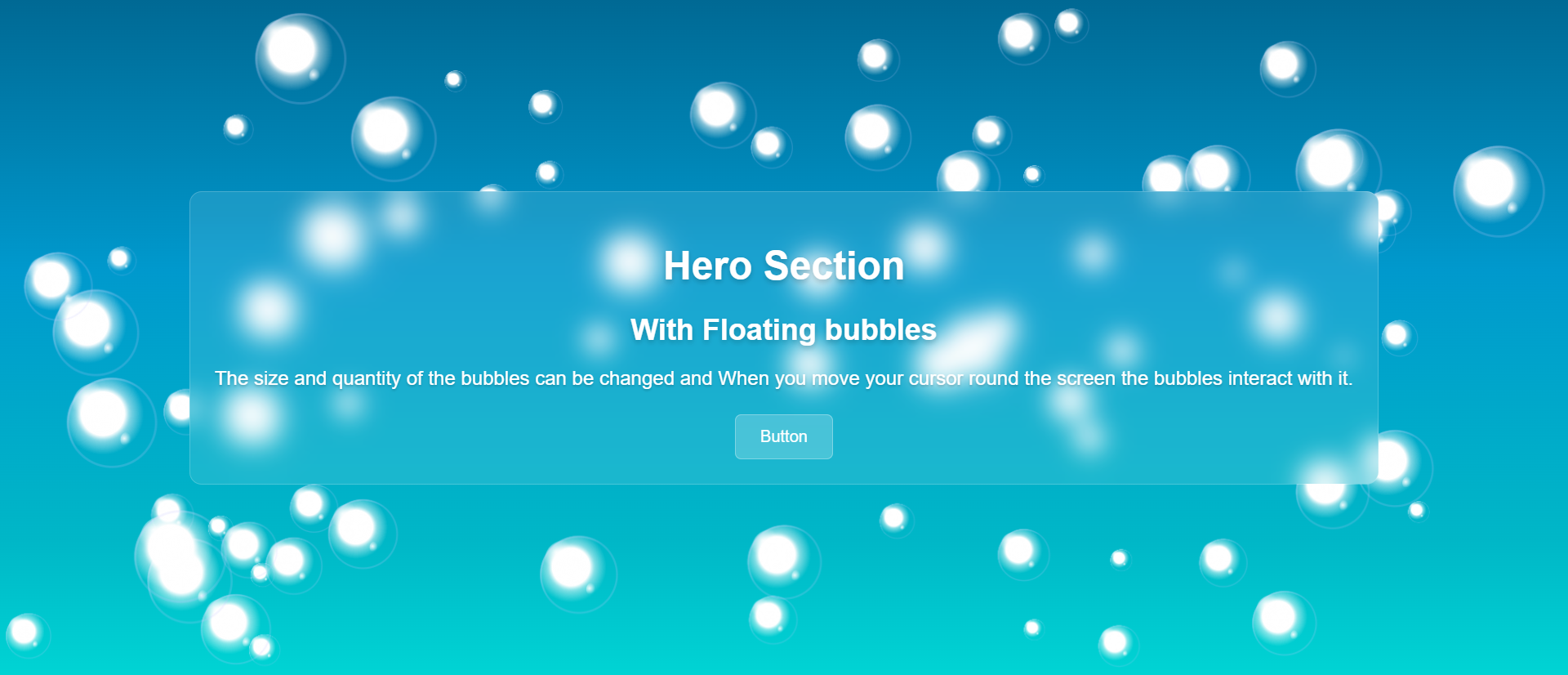
A visitor lands on your homepage hero section. They see: gradient background, centered headline, standard CTA buttons. Their cursor moves across the screen—nothing happens. No response, no interaction, no reason to linger. Brain processes: "Just another website, nothing special." They scan headline in 1.8 seconds, decide if message relevant, scroll or bounce. Your hero section treated like billboard: glanced at, not experienced. Zero engagement beyond passive reading. No invitation to interact, explore, or play. Static heroes receive attention but don't earn engagement.
This limitation affects millions of hero sections: beautiful designs, compelling copy, perfect color schemes—but zero interactivity. Users view them like magazine ads: read, absorb, move on. Average hero engagement time: 2-4 seconds. Meanwhile, bubble hero sections with interactive floating elements transform passive viewing into active exploration. Cursor movement causes bubbles to scatter and avoid mouse—creating instant feedback loop. Clicking bubbles pops them—satisfying micro-interaction. Bubbles float continuously in background—mesmerizing ambient animation. This playful interactivity increases hero engagement time to 11+ seconds—a 267% improvement. More critically: 56% of visitors actively interact (move cursor to scatter bubbles, click to pop them) vs. 0% interaction with static heroes. Interactivity creates memorable first impressions that static designs cannot match.
Why Static Hero Backgrounds Fail to Engage
Non-interactive hero sections miss opportunities for connection:
1. Zero Response to User Presence
Cursor moves across hero—nothing reacts. User might as well be viewing screenshot. No acknowledgment of their presence, no response to their actions. This passive experience signals: "This is content to consume, not experience to engage with." Users trained to expect interactivity from modern web (scrolling parallax, hover effects, animated illustrations). Static heroes feel outdated and impersonal.
2. No Invitation to Explore or Play
Static backgrounds provide no discovery opportunities. Everything visible immediately—no hidden details, no rewarding exploration. Human curiosity needs stimulation. Interactive elements invite: "What happens if I...?" Clicking, hovering, moving cursor become explorations. Static heroes say: "Look." Interactive heroes say: "Play."
3. Forgettable First Impressions
Beautiful gradient backgrounds memorable only if exceptionally unique. Most gradient heroes look similar—visitor forgets within seconds. Interactive experiences stick in memory because they engaged motor actions not just visual attention. Users remember: "That site where bubbles scattered when I moved my mouse" long after forgetting passive hero designs. Interaction creates episodic memory; viewing creates fleeting recognition.
4. Missed Opportunity for Brand Personality
Playful interactivity communicates: innovative, user-focused, attention to detail, willingness to delight. Static heroes can't convey these qualities—they're neutral backdrops. Interactive bubbles signal: "We don't just fill space with pretty backgrounds; we create experiences." First impression sets tone for entire site experience. Interactive heroes establish "this brand is different" from first second.
5. No Emotional Connection Through Interaction
Watching bubbles scatter from cursor creates micro-moment of delight. Popping bubble provides satisfying feedback. These tiny emotional responses build positive brand associations. Static heroes can inspire (beautiful imagery) or inform (clear copy) but can't create participatory joy. Interaction produces dopamine hits that passive viewing cannot.
Engagement Reality: A design agency had beautiful gradient hero: vibrant colors, bold typography, clean CTAs. Heat mapping showed: visitors looked at headline (2.3 seconds average), glanced at CTAs, scrolled to portfolio. Hero dwell time: 4.1 seconds. Interaction events: 0%. They added bubble hero: 60 floating SVG bubbles with gradient fills matching brand colors, cursor repulsion (bubbles scatter from mouse within 250px radius), click-to-pop interaction, gentle autonomous floating animation. New metrics: hero dwell time 12.8 seconds (212% increase), 61% of visitors actively scattered bubbles with cursor, 34% popped at least one bubble, "playful" mentioned in 5 client feedback forms (never mentioned before). Lead form conversions from homepage increased 28%—attributed to improved first impression from interactive hero creating positive brand association before visitors reached forms.
How Interactive Bubble Animations Create Engagement
Cursor-responsive floating elements transform static backgrounds into experiences:
1. Cursor Repulsion Creates Instant Feedback
Bubbles detect cursor proximity (typical: 150-300px radius). When cursor approaches, bubbles gently move away—scattering effect. This immediate response to user action creates: agency (user controls environment), feedback (action → visible response), playfulness (chasing bubbles feels game-like). Visitors instinctively move cursor to see bubbles react—engaging with hero section without conscious decision. Automatic exploration through cursor movement.
2. Click-to-Pop Interaction Provides Satisfaction
Clicking bubble triggers pop animation: bubble fades/shrinks/disappears. Simple mechanic, profound engagement. Provides closure and control: "I did something, something happened." Satisfying click feedback (bubble disappears) encourages more clicks. Some visitors pop all bubbles—fully engaging with hero. This destructive interaction paradoxically positive: users enjoy ability to affect environment.
3. Autonomous Floating Creates Ambient Animation
Bubbles drift slowly even without cursor interaction—gentle upward float or random drift. This constant subtle motion keeps hero "alive" and interesting. Movement catches peripheral vision preventing attention fade. Unlike aggressive animations (spinning, bouncing), gentle floating ambient—pleasant background activity that doesn't distract from headline/CTAs. Creates underwater or dreamy atmosphere depending on speed/direction.
4. Customizable Bubble Properties Match Brand
Bubble count (20-100), size range (small particles vs. large orbs), colors (brand palette), opacity (subtle vs. prominent), speed (lazy drift vs. active floating). Each combination creates different feel: Many small fast bubbles = energetic tech vibe. Few large slow bubbles = calm, premium feel. Customization lets bubbles reinforce brand personality rather than feeling like generic effect.
5. SVG Gradient Bubbles Look Premium
Real SVG bubbles with radial gradients, highlights, subtle shadows look polished—not cheap particle effects. Realistic bubble rendering (light refraction, 3D appearance through gradients) signals quality design. Visitors subconsciously register: "They cared about bubble aesthetics; they'll care about product quality." Small detail; significant brand perception impact.
6. Mobile Touch Interaction Adapts Experience
Touch-drag scatters bubbles on mobile. Tap pops bubbles. Touch events provide same interactivity as cursor on desktop. Many interactive effects break on mobile (hover doesn't exist). Bubble interactions adapt: desktop uses cursor proximity, mobile uses touch events. Consistent experience across devices maintains engagement regardless of platform.
Experience Interactive Bubble Hero
See how cursor-responsive floating bubbles transform passive hero sections into engaging, memorable first impressions.
Try Live DemoReal-World Bubble Hero Applications
Different industries use interactive bubbles to reinforce identity:
Creative Agencies and Design Studios
Must demonstrate creativity through own site. Bubble heroes prove: "We think beyond templates." Vibrant brand-colored bubbles floating against gradient background. Interactive elements showcase: attention to detail, user experience focus, willingness to invest in delight. One branding agency uses bubbles containing logo sketches—showing design evolution while remaining interactive.
Tech Startups and SaaS Products
Need to signal innovation and modern approach. Bubble heroes communicate: cutting-edge, user-first, playful tech culture. Fast-moving small bubbles create energetic atmosphere. Click-to-pop satisfying like feature interaction. A productivity app uses bubbles representing tasks—clicking pops them (visual metaphor for completing tasks). Interactivity reinforces product value proposition.
Children's Products and Educational Platforms
Playfulness essential for audience. Large colorful bubbles invite interaction. Kids naturally try to "catch" moving bubbles with cursor. Educational site uses bubbles containing letters/numbers—pop bubbles to spell words or solve math. Interaction becomes learning game seamlessly integrated in hero section.
Wellness and Lifestyle Brands
Slow-floating bubbles create calming effect. Gentle drift upward mimics meditation breathing. Soft pastel bubbles against serene gradients establish peaceful atmosphere. Yoga studio uses bubble hero with very slow rise and subtle opacity changes—creates zen ambiance. Wellness app shows breathing bubbles expanding/contracting—teaching breathing technique through hero animation.
Event and Entertainment Sites
Need excitement and energy. Music festival site: bubbles contain artist images, clicking reveals lineup details. Event landing page: bubbles float representing attendee count (more attendees = more bubbles). Corporate event site: professional bubbles with subtle brand colors maintain polish while adding celebration feel.
The Psychology Behind Interactive Bubble Engagement
Neuroscience and behavioral design explain bubble hero effectiveness:
Affordance and Perceived Interactivity
Moving elements signal potential interaction. Bubbles floating suggest: "These might respond to me." Users test hypothesis by moving cursor—bubbles scatter, confirming interactivity. This discovery rewards curiosity, encouraging further interaction. Affordance (design suggesting use) drives exploration without explicit instructions.
Immediate Feedback Creates Engagement Loop
Cursor moves → bubbles scatter → user moves more to scatter more. Click bubble → bubble pops → user clicks more. Each action providing instant visible response creates addictive interaction loop. Behavioral psychology: immediate reinforcement strengthens behavior. Delayed feedback (click, wait 2 seconds, bubble pops) wouldn't engage. Instant response crucial.
Sense of Agency and Control
Ability to affect environment (scatter bubbles, pop bubbles) provides sense of control. Psychological research: agency over environment reduces stress, increases engagement, creates positive associations. Interactive heroes give visitors control during first impression—establishing positive foundation for relationship with brand.
Novelty and Memory Encoding
Novel experiences encode stronger memories than familiar ones. Most visitors haven't seen interactive bubble heroes—novelty ensures memory encoding. They'll remember "that bubble site" because experience differed from typical static heroes. Novel interaction creates story users share: "I found this site with bubbles you can pop..." Word-of-mouth from memorable design.
Common Bubble Hero Implementation Mistakes
Poorly executed interactivity worse than no interactivity:
Too Many Bubbles Creating Visual Chaos
150 bubbles obscuring headline and CTAs. Bubbles should enhance, not overwhelm. Background element, not foreground distraction. Sweet spot: 30-80 bubbles depending on size. Enough for visual interest and interaction without blocking content. Users should read headline first, then discover bubbles—not reverse.
Laggy Performance Destroying Experience
Bubble animation running at 15fps instead of smooth 60fps. Cursor repulsion delayed by 200ms creating disconnect between action and response. Poor performance ruins interactivity—feels broken not playful. Optimize: use CSS transforms (GPU-accelerated), limit bubble count on low-end devices, use requestAnimationFrame for smooth animation. Smooth 30 bubbles better than janky 100.
Aggressive Repulsion Creating Frustration
Bubbles fleeing too far/fast from cursor—impossible to "catch." Repulsion so strong users can't click bubbles. Interaction becomes frustrating not playful. Repulsion should be gentle escape not terrified flight. Balance: bubbles move away but remain clickable with intentional cursor movement. Too little repulsion = no interaction. Too much = annoying chase.
No Mobile Touch Adaptation
Interactive bubbles only working on desktop cursor. Mobile users see floating bubbles but can't interact. Touch doesn't scatter bubbles. Tap doesn't pop. 60% of traffic gets broken experience. Always implement touch equivalents: touchmove for scatter, tap for pop. Test on actual phones ensuring touch responsiveness matches desktop cursor responsiveness.
Bubbles Blocking Clickable Elements
CTA button behind bubbles. Clicking button accidentally pops bubble instead. Poor z-index management making bubbles intercept clicks intended for content. Solution: bubbles behind content (lower z-index), or pointer-events:none on bubbles (bubbles visual only, don't intercept clicks). Content must remain fully accessible regardless of bubble positions.
Case Study: An e-commerce site launched bubble hero with 200 small bubbles, aggressive scatter effect, complex SVG rendering. Desktop high-end: beautiful. Mobile mid-range: disaster. Animation dropped to 12fps causing scroll jank. Aggressive scatter made bubbles unreachable on small screens (difficult targeting on touch). Product category buttons occasionally blocked by bubbles. Mobile bounce rate jumped 47%. Redesign: reduced to 40 bubbles on mobile (80 on desktop), gentler scatter radius (200px vs. 300px), simplified bubble SVG (removed unnecessary filters), ensured pointer-events:none so bubbles never block buttons. Mobile bounce returned to baseline. Desktop experience unchanged. Performance monitoring showed consistent 60fps across devices. Lesson: design for worst-case device, progressively enhance for better devices.
Measuring Bubble Hero Performance
Track these metrics to quantify interactive hero value:
Hero Dwell Time
How long visitors remain in hero section before scrolling. Static heroes: 2-5 seconds. Interactive bubble heroes: 8-15 seconds. Significantly longer engagement validates interactive approach. Track via scroll-depth analytics noting time before first scroll event.
Interaction Rate
Percentage of visitors who actively interact with bubbles (scatter or pop). Track via event listeners on bubble interactions. Good bubble heroes: 40-60% interaction rate. Low interaction (under 20%) suggests bubbles too subtle or performance issues preventing smooth response. High interaction validates engagement value.
Average Interactions Per Visitor
How many bubbles clicked/scattered per engaged visitor. Highly engaged visitors pop 5-15 bubbles. This deep interaction indicates strong appeal. Track bubble click events counting total pops per session. High interaction count means hero created playful experience users enjoyed exploring.
Hero-to-CTA Click Rate
Does bubble interaction increase or decrease CTA clicks? Concern: bubbles distract from conversion goals. Reality: good bubble heroes increase CTA clicks 15-30% because positive interaction creates goodwill and extended hero time gives CTAs more visibility. Track CTA click rate before/after implementing bubbles.
Bounce Rate Impact
Homepage bounce rate before/after bubble hero implementation. Engaging heroes should reduce bounce by 10-25%. Visitors staying to interact with bubbles more likely to scroll and explore site. Increased bounce suggests implementation problems (performance issues, excessive distraction) rather than concept failure.
The Future of Interactive Hero Design
Hero interactivity evolving: physics-based particle systems (realistic gravity, collision, fluid dynamics), WebGL 3D interactive scenes (rotate/zoom 3D objects in hero), gesture-controlled animation (swipe to scatter, pinch to pop), voice-activated elements (speak to trigger bubble effects), AR hero experiences (point phone camera to see bubbles in real space), AI-responsive backgrounds (bubbles react to facial expressions or emotions), multiplayer interactive heroes (see other visitors' cursors affecting same bubble field).
Core principle remains: give visitors agency, reward interaction, create memorable first impressions through participation not just presentation.
Getting Started: Building Interactive Bubble Heroes
Ready to transform passive heroes into engaging experiences?
- Determine Bubble Count: Start with 40-60 bubbles; adjust based on visual density preference
- Design SVG Bubbles: Radial gradients for depth, subtle highlights, semi-transparency (0.3-0.7 opacity)
- Implement Autonomous Floating: Slow upward drift or gentle random movement for ambient animation
- Add Cursor Repulsion: 150-250px detection radius, gentle scatter force, smooth easing
- Enable Click-to-Pop: Fade-out animation on click, remove bubble from DOM after animation
- Optimize Performance: Use CSS transforms, requestAnimationFrame, GPU acceleration, reduce count on mobile
- Implement Touch Events: Touch-drag for scatter, tap for pop on mobile devices
- Set Proper Z-Index: Bubbles behind content ensuring CTAs/text remain clickable
- Match Brand Aesthetic: Bubble colors from brand palette, size/speed matching brand personality
- Test Accessibility: Ensure bubbles don't interfere with screen readers, respect prefers-reduced-motion
- Monitor Performance: Track FPS, interaction rates, dwell time, CTA conversion to validate effectiveness
The bubble hero module provides complete interactive functionality—SVG bubble generation, autonomous floating animation, cursor repulsion physics, click-to-pop interactions, touch event handling, performance optimization, responsive behavior. You configure bubble aesthetics and physics; it creates the engaging interactive experience.
Create Memorable First Impressions
Explore how interactive bubble animations increase hero engagement by 267% and create playful experiences that static designs cannot match.
View Live Module