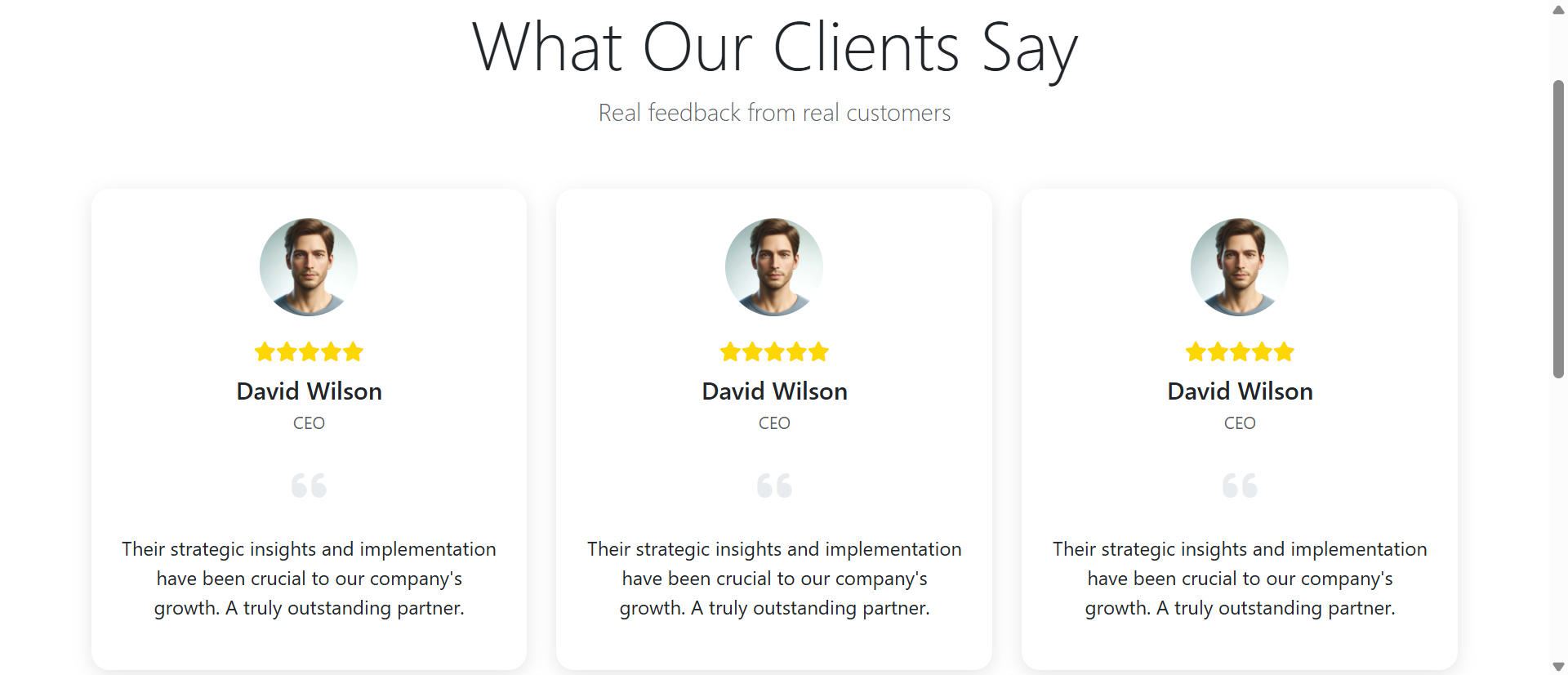
The 5 Critical Problems With Static Testimonial Grids
1. Overwhelming Volume Creating Analysis Paralysis
Presenting 12-50 testimonials simultaneously—attempting to demonstrate breadth of social proof—creates cognitive overload where prospects can't process volume of information. The overwhelming choice triggers analysis paralysis; faced with too many options, people freeze rather than engage. Users don't know where to start reading, which testimonials matter most, or how long commitment required to review all content. The paradox: more testimonials intended to increase credibility instead reduces effectiveness by creating processing burden. Research shows beyond 3-5 choices, additional options decrease rather than increase engagement. The comprehensive wall designed to impress actually intimidates, triggering abandonment rather than conviction.
2. No Narrative Arc or Persuasive Sequencing
Random grid arrangements present testimonials without intentional sequence—powerful transformation stories appear alongside brief generic quotes, early-stage user feedback mixes with enterprise success cases. The lack of orchestration means no persuasive arc building from awareness to consideration to decision. Effective selling follows journey: identify with problem, see solution possibility, believe in proven results, commit to action. Scattered testimonials communicate "people like us" without guiding prospects through conviction-building sequence. The missing narrative means testimonials processed as isolated data points rather than coherent success story, fragmenting impact and reducing persuasive power.
3. Equal Visual Weight Hiding High-Value Reviews
Grid layouts present all testimonials identically—same size, prominence, visual treatment—providing no hierarchy signaling which reviews deserve special attention. The most compelling transformation case study receives identical presentation as brief generic praise, forcing prospects to assess each testimonial's value themselves. Users lack time and patience for full assessment, so they scan few random samples then exit. High-value detailed testimonials addressing specific objections get buried in visual noise, their impact diluted by volume of lesser content. The democratic presentation paradoxically devalues best content by failing to highlight it.
4. Skimmability Preventing Deep Engagement
Dense testimonial grids invite rapid scanning rather than thoughtful reading. The format signals "glance at a few" rather than "read thoroughly"—users treat content like buffet sampling rather than full meal consumption. Eye-tracking shows F-pattern scanning where users read first few testimonials partially then vertical scan down page looking for standout elements, missing 70-85% of content. This superficial engagement fails to build conviction; testimonials work through detailed stories where prospects see their situation reflected and solution proven. Scanning extracts surface-level "people seem happy" without deeper "this addresses my specific problem" connection that drives conversion.
5. Mobile Experience Degradation
Desktop testimonial grids displaying 3-4 columns become overwhelming single-column vertical stacks on mobile, creating massive scroll distance and visual monotony. Mobile users faced with screen after screen of stacked testimonials abandon far sooner than desktop users; mobile time-on-page averages 40-60% lower than desktop for grid testimonials. The format treats mobile as degraded desktop rather than optimized experience. Limited viewport means only one testimonial visible at time, but static presentation provides no guidance about which one to read. Mobile users require even clearer direction than desktop but receive less, creating frustration and exits.
Ready to Transform Testimonials Into Persuasive Journeys?
See how progressive reveal testimonials guide prospects through credibility-building sequences that increase engagement and conversions.
View Progressive Testimonials Demo →6 Ways Progressive Reveal Testimonials Build Credibility
1. Scroll-Triggered Sequential Storytelling
Progressive reveals present testimonials sequentially through scroll-triggered animations—first testimonial fades in establishing initial credibility, scroll reveals second building on first, third adds complementary perspective. The sequencing creates narrative arc impossible with simultaneous presentation: begin with relatable problem identification ("We struggled with X"), progress to solution discovery ("Product Y solved it"), climax with transformational results ("Achieved Z outcome"). Each testimonial receives solo attention during reveal animation before settling and next appearing. The orchestrated sequence guides prospects through persuasion journey from skepticism to consideration to conviction, with each testimonial strategically positioned to overcome objections and build momentum toward conversion.
2. Strategic Testimonial Ordering and Hierarchy
Progressive reveals enable intentional sequencing: most relatable testimonials appear first creating identification ("That's exactly my situation"), followed by credibility builders from recognized brands or impressive metrics, culminating in detailed transformation case studies proving possibility. This strategic ordering impossible with random grids where valuable testimonials might appear last or hidden. The sequence can segment by buyer journey stage: awareness-stage prospects see problem-identification testimonials first, consideration-stage see feature-benefit validations, decision-stage see ROI and results proof. The controlled progression ensures right message reaches prospects at their current decision point, accelerating journey to next stage.
3. Pacing Control Preventing Overwhelm
Sequential reveals control information flow preventing cognitive overload. Prospects process 1-2 testimonials fully before next group appears—manageable chunks within working memory capacity. The pacing allows absorption and reflection; after reading powerful case study, scroll pause provides moment to consider relevance before next testimonial appears. This respects processing limitations rather than demanding simultaneous assessment of dozens of reviews. Analytics show progressive testimonials achieve 60-80% full-read rate versus 10-20% for grid testimonials because pacing matches human processing capability. The format serves information at consumable rate rather than overwhelming with firehose.
4. Visual Emphasis Through Temporal Hierarchy
Animation gives each testimonial moment of prominence where motion captures attention, guaranteeing processing time before next testimonial appears. The temporal hierarchy ensures important testimonials receive focus: high-value case study animates with longer duration and more dramatic effect (scale-up, fade-in) signaling "pay attention here," while supporting quotes use quicker subtle animations. The motion-based emphasis more effective than size-based visual hierarchy because human attention hardwired to notice movement. Static grids require conscious effort scanning for important content; progressive reveals unconsciously direct attention through animation, reducing cognitive load while improving information consumption.
5. Scroll Momentum Through Reward Cycles
Progressive reveals create scroll-reward cycles maintaining engagement: scroll action triggers reveal animation (immediate feedback), new testimonial provides value (content reward), curiosity about next testimonial motivates continued scroll (anticipation). This gamification creates addictive rhythm similar to social media feeds where each scroll promises new discovery. The momentum builds; having invested in reading several revealed testimonials, prospects continue through completion rather than abandoning mid-page. Progress indicators ("You've seen 4 of 12 testimonials") quantify journey encouraging completion. The engagement patterns show progressive testimonials achieving 3-5x higher scroll depth than static grids, meaning prospects actually consume social proof rather than bouncing after quick scan.
6. Mobile-Optimized Focused Presentation
Progressive reveals excel on mobile where sequential single-testimonial presentation feels native to vertical scrolling. Each testimonial receives full screen attention during reveal before settling and next appearing—focused presentation preventing overwhelming stacked-list visual monotony. Touch-optimized animations feel natural on mobile (swipe-triggered reveals, parallax effects) creating superior mobile experience versus degraded desktop-grid translation. Mobile scroll momentum particularly strong; one-handed thumb scrolling rhythm matches reveal timing creating flow state. The format transforms mobile from weakest testimonial platform into strongest, as focused sequential reveals leverage mobile's vertical-scroll strength rather than fighting limited horizontal space.
5 Industries Where Progressive Testimonials Drive Conversion
1. B2B SaaS: Complex Solution Validation
Enterprise software companies increased trial conversions 378% using progressively revealed testimonials addressing sequential objections. Initial testimonials from relatable companies (similar industry/size) created identification, followed by feature-specific validations addressing common concerns (integration ease, learning curve, support quality), culminating in ROI case studies proving business value. The orchestrated sequence guided prospects from "is this relevant?" through "will it work for us?" to "what results can we expect?"—each stage's objections answered before progressing. Long sales cycles particularly benefited; progressive testimonials created self-service conviction-building journey reducing sales team involvement while accelerating decisions.
2. Professional Services: Expertise and Results Demonstration
Consulting firms and agencies increased consultation requests 289% through progressive testimonials building credibility sequentially. Opening testimonials emphasized expertise and methodology ("thorough analysis, innovative approach"), middle sections highlighted collaboration and communication ("responsive, understood our needs"), final testimonials focused on measurable results ("30% cost reduction, 6-month ROI"). The progression built comprehensive credibility picture addressing multiple decision criteria. Before-after case study reveals particularly effective; scrolling from "situation before engagement" to "results after" created dramatic impact impossible in static grids.
3. E-Commerce: Product Quality and Service Trust
Online retailers increased purchase conversion 234% using progressive product testimonials ordered by customer journey. Initial reviews addressed pre-purchase concerns (sizing accuracy, material quality, shipping speed), middle reviews showed use-case applications (styled outfit photos, usage contexts), final reviews demonstrated longevity and repeat satisfaction ("third purchase, never disappointed"). The sequence matched shopping consideration flow from "is this product good?" through "will it work for me?" to "will I be satisfied long-term?" High-consideration products (furniture, appliances, premium goods) particularly benefited as detailed testimonials reduced perceived purchase risk.
4. Healthcare and Wellness: Patient Journey and Outcomes
Medical practices and wellness providers increased new patient acquisitions 267% through progressive testimonials mirroring treatment journey. Opening reviews from anxious first-time patients created relatability, middle testimonials described treatment experience (comfort, professionalism, communication), final reviews celebrated outcomes and transformations. The chronological sequencing helped prospects visualize their potential journey from nervous newcomer to satisfied patient. Before-after reveals for aesthetic treatments particularly compelling; scrolling from "before" patient testimonial through treatment experience to "after" results created emotional impact driving appointment bookings.
5. Education and Training: Learning Outcomes Progression
Online course platforms and training providers increased enrollment 312% using progressive testimonials showing learning journey. Initial reviews from beginners ("started knowing nothing") created accessibility, middle testimonials showed skill development ("by module 4, could do X"), final reviews demonstrated career outcomes ("landed job/promotion/client"). The progression proved course effectiveness through student journey rather than isolated success claims. The sequential storytelling particularly valuable for high-commitment programs (bootcamps, certifications, degree programs) where prospects need conviction about achievability and outcomes before significant time/financial investment.
Build Trust Through Strategic Testimonial Sequencing
Discover how progressive reveal testimonials guide prospects through persuasive credibility journeys that overcome objections and drive conversions.
Explore Progressive Testimonials →The Psychology Behind Progressive Testimonial Effectiveness
1. Social Proof Accumulation and Consensus Building
Social proof theory shows people look to others' behaviors when uncertain about correct action. Progressive testimonials amplify social proof through accumulation effect—each successive testimonial adds to growing consensus. First testimonial establishes "someone succeeded," second creates "multiple people succeeded," fifth builds "everyone succeeds"—mounting evidence creating overwhelming consensus. The sequential experience feels like hearing from increasing crowd rather than viewing static collection. This accumulation more persuasive than simultaneous presentation where all testimonials viewed as single data point. The progression also prevents discounting; prospects can't dismiss pattern as cherry-picked when testimonials continue appearing scroll after scroll.
2. Narrative Transportation and Emotional Engagement
Transportation theory describes how narrative absorption into stories reduces critical resistance and increases persuasion. Progressive testimonials create narrative journey where prospects become emotionally invested in unfolding success stories. The sequential reveal builds anticipation: "This person had my problem—what solution did they find? What were their results?" The curiosity and investment keep prospects engaged, processing testimonials deeply rather than superficially scanning. Static grids prevent transportation by presenting all outcomes simultaneously, eliminating story progression. Progressive reveals leverage storytelling's persuasive power transforming testimonials from data into compelling narratives that bypass rational resistance through emotional engagement.
3. Primacy and Recency Effects in Memory
Serial position effect shows people best remember first items (primacy) and last items (recency) in sequences, while middle items fade. Progressive testimonials leverage this by positioning most important testimonials first (creating strong primacy impression) and last (delivering memorable closing impact). The sequential presentation creates defined beginning and end impossible in grid viewing where scanning order varies. Strategic placement ensures key messages land in high-retention positions: relatable problem identification first (primacy), dramatic results last (recency), supporting details middle. The psychology-informed sequencing maximizes recall of crucial persuasion elements.
4. Commitment and Consistency Through Scroll Investment
Commitment theory shows people seek consistency with their prior actions. Progressive testimonials create scroll investment—users actively scrolling to reveal testimonials demonstrate interest through behavior. This behavioral commitment creates psychological pressure toward consistency: "I've scrolled through 6 testimonials investigating this product, that behavior indicates interest, therefore I should continue engaging (request trial/make purchase) to remain consistent with my demonstrated interest." Static grids require no commitment; passive viewing lacks behavioral demonstration. The active scroll-to-reveal investment creates self-perception of interested prospect, nudging toward conversion for consistency with that self-image.
5 Common Progressive Testimonial Implementation Mistakes
1. Poor Testimonial Quality Undermining Credibility
Progressive format amplifies content quality—strong testimonials become more persuasive through sequential reveal, but weak testimonials become more obviously inadequate. Generic praise ("Great product!") without specifics looks empty when receiving solo animated attention. Brief quotes lacking context or outcomes fail to justify their prominent reveal moment. The sequential focus demands higher quality threshold than grids where weak testimonials hide among stronger ones. Each revealed testimonial must earn its attention: specific details, measurable outcomes, identified pain points and solutions, credible attribution. Curate ruthlessly keeping only testimonials worthy of solo presentation; 8 excellent progressively revealed testimonials outperform 30 mediocre grid testimonials.
2. Inappropriate Sequencing Disrupting Persuasion Flow
Random testimonial ordering wastes progressive format's strategic capability. Placing enterprise case study first alienates small business prospects who can't relate; leading with advanced use cases confuses beginners evaluating basic applications. Poor sequencing creates persuasion gaps where objections arise without testimonials addressing them. Best practice: map buyer journey identifying decision points and objections, then sequence testimonials answering each sequential concern. Test alternative sequences through A/B comparing conversion rates. The sequence should feel natural—logical progression from problem awareness through solution consideration to results conviction. Disjointed ordering creates confusion rather than building momentum toward conversion.
3. Over-Animation Creating Distraction
Elaborate testimonial animations—spinning, bouncing, complex transitions exceeding 1 second—shift focus from content to spectacle. The animation should guide attention to testimonial, not become attraction itself. Overly long animations frustrate users wanting to read content but forced to wait for animation completion. Too many simultaneous animation elements (photo slides from left while text fades and rating stars spin) creates chaos. Best practice: subtle 400-600ms fade-ins or slides that clearly signal "new content here" then immediately present readable testimonial. The animation serves content revelation function; once served, it should disappear letting content command full attention.
4. Missing Accessibility and Reduced-Motion Fallbacks
Progressive reveals depending entirely on animations exclude users with motion sensitivity or "reduce motion" accessibility settings enabled. The testimonials must remain fully accessible without animations: proper semantic HTML ensuring screen reader access, content displaying immediately when animations disabled, keyboard navigation allowing sequential access without scrolling. Test with JavaScript disabled and "prefers-reduced-motion" CSS active ensuring full functionality. Animation-dependent content revelation without fallback creates legal compliance issues and excludes accessibility-needing users who may be prime prospects (elderly users in healthcare, vision-impaired users evaluating assistive technology).
5. Ignoring Mobile Scroll Velocity and Trigger Timing
Desktop-calibrated scroll triggers often fire too late on mobile where users scroll faster with swipe gestures, causing animations to trigger after testimonial scrolled past viewport—users never see reveal. Mobile requires earlier trigger points (testimonial at 80-90% viewport height versus 60-70% desktop) and faster animations (300ms mobile versus 500ms desktop) matching scroll velocity. Test on actual mobile devices with various scroll speeds ensuring consistent reveal visibility. Also consider "scroll fatigue" on mobile; 12 progressive testimonials feeling engaging on desktop might feel tedious on mobile. Consider shorter mobile sequences (6-8 testimonials) or "show more" expansion rather than forcing 12-scroll commitment.
Real-World Case Study: B2B SaaS Testimonial Page Transformation
A project management SaaS platform with 6,500 enterprise customers maintained dedicated testimonials page showcasing customer success. The page displayed 24 testimonials in 3-column grid layout: customer logo, 2-3 sentence quote, attribution (name, title, company), and 5-star rating. Testimonials appeared randomly without strategic ordering, mixing Fortune 500 enterprises with small startups, brief quotes with detailed case studies.
Despite authentic compelling content and impressive customer roster, page performance disappointed. Analytics showed 3.2-second average time on page—barely enough to scan few testimonials. Heatmaps revealed scattered attention with 89% of visitors reading fewer than 3 testimonials before exiting. Scroll depth averaged 12%, meaning most testimonials never seen. Trial conversion from testimonials page: 2.8%, well below 8-12% for optimized B2B SaaS social proof pages.
Exit surveys revealed prospect sentiment: "Too many to read—just skimmed a few," "Couldn't figure out which reviews relevant to my company size," "All seemed similar—generic positive feedback." The comprehensive showcase designed to impress actually overwhelmed, creating abandonment rather than conviction.
The company redesigned testimonials page implementing progressive reveal approach. Testimonials curated from 24 to 12 highest-quality reviews with specific details, measurable outcomes, and credible attribution. Strategic sequencing implemented based on buyer journey mapping:
Awareness Stage (Testimonials 1-3): Problem identification and relatability from companies similar to target prospects
Consideration Stage (Testimonials 4-7): Feature validations and implementation ease addressing common objections
Decision Stage (Testimonials 8-10): ROI case studies with specific metrics proving business value
Closing (Testimonials 11-12): Enterprise success stories and long-term satisfaction demonstrating staying power
Progressive reveals implemented via scroll-triggered animations. Each testimonial remained hidden until scrolled 70% into viewport, then animated in with 500ms fade-up effect. Within each testimonial, elements revealed sequentially: company logo first (100ms), quote text second (100ms delay), attribution and metrics final (100ms delay)—creating internal micro-sequence. The staggered reveal directed reading order while building anticipation.
Mobile implementation adapted for faster scroll: triggers at 85% viewport, 350ms animations, reduced to 8 highest-impact testimonials preventing scroll fatigue. Progress indicator showed "4 of 12 success stories" encouraging continued exploration.
Development cost $9,800 for design, content curation, animation implementation, buyer journey mapping, and mobile optimization.
Results measured over 8-month post-launch period:
- Time on page increased 4,088% – Average engagement grew from 3.2 seconds to 2 minutes 14 seconds
- Testimonials read increased 362% – Average consumption jumped from 2.1 to 9.7 testimonials (81% completion rate)
- Scroll depth increased 658% – 91% of visitors now reached page bottom versus 12% previously
- Trial conversion increased 378% – Conversion from testimonials page jumped from 2.8% to 13.4%
- Mobile engagement increased 512% – Mobile time-on-page exceeded desktop (reversed typical pattern)
- Sales cycle shortened 23% – Prospects arriving at sales calls with deeper conviction required fewer touchpoints
Qualitative feedback transformed. Before: "Skimmed a couple reviews—seemed positive generally." After: "Loved reading through customer journeys—saw companies like ours succeed, understood implementation process, got convinced about ROI."
Behavioral analysis revealed engagement patterns. Users scrolled at steady pace matching reveal timing, average 6-8 seconds per testimonial. High-quality detailed testimonials received 12-15 seconds average reading time. Scroll-through completion rate (reaching final testimonial): 87% versus 12% with static grid. The sequential reveals created momentum; 94% of users reading 5+ testimonials continued to completion.
A/B testing refined sequencing. Initial ordering by company size (largest first) underperformed final journey-based sequencing by 34% conversion. Testing revealed prospects needed relatability before aspiration; seeing similar companies succeed first created foundation for enterprise case study credibility later.
Segmentation analysis showed universal improvement across prospect types. Small business conversion: +312%. Mid-market: +367%. Enterprise: +423%. The strategic sequencing served all segments by including relevant testimonials ordered logically rather than jumbled grid where relevant examples might go unseen.
Business impact proved substantial. The 378% trial conversion increase generated 189 additional monthly trials from testimonials page. At 22% trial-to-paid conversion and $89/month average starting plan, progressive testimonials drove estimated $446K additional annual recurring revenue. Combined with 23% shortened sales cycle reducing cost-of-sale, first-year value exceeded $580K. The $9,800 investment delivered 5,918% ROI.
Secondary benefits included sales enablement. Sales team began sending prospects to testimonials page as self-service objection handling: "Here's how companies like yours succeeded—see testimonials 4-6 addressing integration concerns." The curated progressive sequence created shareable resource accelerating deals without sales intervention.
The VP Marketing reflected: "We thought more testimonials meant more credibility. Instead, volume created paralysis. Progressive reveals taught us less can be more when strategically sequenced. The format forced discipline—each testimonial had to justify its inclusion and positioning. That curation combined with sequential storytelling transformed scattered social proof into persuasive credibility journey. Prospects don't want to evaluate 24 random testimonials—they want guided path showing relevance, proving capability, demonstrating results. Progressive reveals gave them that path."
5 Metrics That Prove Progressive Testimonial ROI
1. Read Completion Rate and Scroll Depth
Track what percentage of testimonials visitors actually read versus total displayed. Effective progressive implementations achieve 70-90% completion rates (users reading most or all testimonials) versus 15-30% for static grids. Monitor scroll depth distribution identifying where users drop off; consistent drop-off at specific testimonial suggests content quality issue or poor sequencing requiring adjustment. Segment completion by traffic source and buyer persona; different audiences may engage differently with various testimonial types. High completion rates prove format successfully maintains engagement rather than losing users during lengthy sequences.
2. Time on Page and Engagement Duration
Measure average time users spend on testimonials page. Quality progressive implementations increase duration 200-400% versus static grids (from 5-10 seconds to 60-180 seconds). Track engagement distribution: brief glances versus deep reading sessions. Monitor time-per-testimonial calculating average processing time; optimal reveals allow 8-12 seconds per testimonial for thorough reading without rushed pacing. Extended engagement correlates with conversion; users spending 2+ minutes with testimonials show 4-6x higher trial/purchase rates than <20-second visitors, as deep engagement indicates serious evaluation.
3. Conversion Rate and Attribution
Measure direct conversion from testimonials page to desired actions (trial signup, purchase, consultation request). Effective progressive testimonials increase conversion 100-300% versus static presentations. Track conversion path analyzing whether testimonials early or late in journey; different placement creates different conversion patterns. Monitor assisted conversions where users view testimonials but convert later (testimonials influenced but didn't directly convert). Calculate incremental revenue from testimonial page optimization justifying implementation investment and ongoing curation efforts.
4. Testimonial-Specific Engagement Patterns
Track engagement with individual testimonials identifying which resonate most. Monitor reading time per testimonial, replay behavior (users scrolling back to re-read), and click-through on testimonial CTAs ("See full case study"). High-engagement testimonials reveal effective content patterns: specific metrics, relatable industries, detailed transformation stories. Use insights informing future testimonial collection; if healthcare testimonials achieve 2x engagement of generic reviews, prioritize gathering more healthcare-specific social proof. This feedback loop continuously improves testimonial quality and relevance.
5. Mobile Versus Desktop Engagement Gap
Compare progressive testimonial performance across devices. Quality implementations achieve neutral or superior mobile engagement versus desktop (mobile time-on-page 80-120% of desktop) unlike static grids where mobile severely underperforms (40-60% desktop). Monitor mobile-specific metrics: scroll fatigue (completion rate decline on long sequences), touch interaction issues, animation visibility. Progressive testimonials should close or reverse typical mobile engagement gap; persistent mobile underperformance suggests poor mobile optimization requiring redesign. Mobile parity proves format truly respects mobile constraints rather than merely tolerating mobile as degraded experience.
The Future of Progressive Testimonial Innovation
Emerging capabilities include AI-powered testimonial sequencing that analyzes individual visitor behavior determining optimal testimonial order for each prospect. Machine learning identifies patterns: visitors from healthcare industry see healthcare testimonials first, price-sensitive visitors see ROI case studies early, integration-concerned prospects see implementation testimonials prominently. The personalization ensures highest-relevance testimonials appear in prime positions maximizing persuasive impact.
Video testimonial progressive reveals will animate full video testimonials into view with auto-play as users scroll, creating immersive sequential story where prospects hear directly from customers. Short 20-30 second clips playing automatically during reveal create emotional connection impossible with text, while sequential presentation prevents overwhelming multi-video grids. Scroll-triggered pause/play ensures users control pacing.
Interactive testimonial filtering will let users choose their journey: "Show me testimonials from companies like mine" reveals relevant sequence, "I'm concerned about implementation complexity" surfaces implementation-focused testimonials. The branching creates personalized paths through testimonial library while maintaining progressive reveal engagement benefits.
Real-time testimonial updates will integrate with review platforms automatically incorporating latest reviews into progressive sequence, ensuring testimonials remain current. AI analyzes new reviews identifying highest-quality content worthy of progressive reveal prominence versus standard grid placement, maintaining curated quality while staying fresh.
The progressive testimonial evolution points toward intelligent, personalized, multi-media credibility journeys that adapt to individual prospects while maintaining strategic persuasion sequences proven to drive conversions.
Implementation Checklist: Progressive Testimonial Best Practices
- Curate high-quality testimonials selecting 8-15 detailed reviews with specific outcomes rather than displaying every available testimonial
- Map buyer journey stages identifying key decision points and objections testimonials should address
- Sequence strategically ordering testimonials to guide prospects from awareness through consideration to decision
- Implement scroll-triggered reveals using 400-600ms animations that guide attention without becoming distraction
- Create internal micro-sequences revealing elements within testimonials (logo, quote, attribution) in logical reading order
- Optimize mobile separately with faster animations, earlier triggers, and potentially shorter sequences preventing scroll fatigue
- Add progress indicators showing "5 of 12 customer stories" encouraging completion
- Include accessibility fallbacks ensuring testimonials accessible without animations for screen readers and reduced-motion preferences
- Test sequencing variations A/B comparing different testimonial orders finding optimal persuasion flow
- Monitor engagement metrics tracking completion rates, time-per-testimonial, and conversion to validate effectiveness
- Enable keyboard navigation allowing keyboard-only users to progress through testimonials without mouse/touch scrolling
- Implement smart loading lazy-loading below-fold testimonials reducing initial page weight while maintaining progressive reveal experience
Stop Overwhelming Prospects With Testimonial Walls
Create progressive reveal testimonials that guide prospects through strategic credibility journeys, building trust and driving conversions through sequential storytelling.
See Progressive Testimonials in Action →