The 5 Critical Problems With Invisible Site Activity
1. Static Sites Appear Inactive or Abandoned
Websites showing no activity signals create impression of dormancy—visitors can't distinguish between thriving platform with thousands of daily users and abandoned site with zero engagement. This ambiguity breeds skepticism particularly for unfamiliar brands where visitors lack prior trust foundation. E-commerce sites without visible purchase activity, SaaS platforms showing no usage indicators, or course platforms hiding enrollment data all suffer perception of low adoption. The skepticism becomes self-fulfilling: visitors hesitate to become "first customer" of apparently inactive service, further suppressing conversion. Making activity visible proves platform viability, breaking skepticism cycle.
2. Missed Social Validation Opportunities
Social proof—evidence that others validate your offering through their actions—is among the most powerful conversion influencers, yet most sites waste this asset by hiding it. Every purchase, signup, download, or positive action represents social endorsement, but invisible activity provides zero validation benefit. When visitors can't see others actively engaging, they lose the reassurance that "people like me are choosing this solution." The waste is tragic: sites with robust activity fail to leverage that momentum for conversion because they don't surface it. Social validation works passively through visibility; hiding activity eliminates this powerful trust mechanism.
3. No FOMO (Fear of Missing Out) Activation
FOMO psychology—anxiety about missing valuable opportunities others are accessing—drives urgent action, but requires awareness of others' participation. Hidden activity can't trigger FOMO because visitors don't know what they're potentially missing. When users see "127 people viewing this course" or "Sarah from London just enrolled," they experience competitive urgency: "Others are benefiting, I should too." Without visibility into concurrent activity or recent actions, this urgency mechanism never activates. Sites with high activity but low visibility miss the conversion acceleration FOMO provides, leaving prospects in leisurely browsing mode rather than urgent decision-making.
4. Lack of Recency Signals Suggesting Relevance
Recent activity signals current relevance and ongoing maintenance; lack of recency indicators creates uncertainty about whether offering remains actively supported. Course platforms without recent enrollment notifications make visitors question if content is outdated. SaaS tools without recent signup activity suggest possible decline or superior competitor emergence. E-commerce without recent purchase signals raises quality concerns: "Why isn't anyone buying this?" Recency matters because it proves present-tense validation, not just historical success. Without visible recent activity, visitors assume worst-case scenarios about relevance and quality.
5. Competitive Disadvantage Against Proof-Displaying Rivals
When competitors display social proof notifications while you don't, prospects directly compare perceived popularity. Visitors seeing competitor site with "43 people viewing this product" notification then visiting your equivalent product page with no activity signals unconsciously infer competitor superiority. The comparison isn't rational—your product may have higher actual volume—but perception drives decisions. Competitors leveraging social proof notifications gain unfair advantage simply through transparency, while your hidden activity might as well not exist. The competitive pressure intensifies as social proof becomes industry standard; abstaining increasingly signals weakness.
Ready to Transform Activity Into Trust?
See how social proof notifications turn invisible engagement into powerful conversion drivers through real-time activity transparency.
View Social Proof Demo →6 Ways Social Proof Notifications Drive Conversions
1. Real-Time Purchase and Signup Notifications
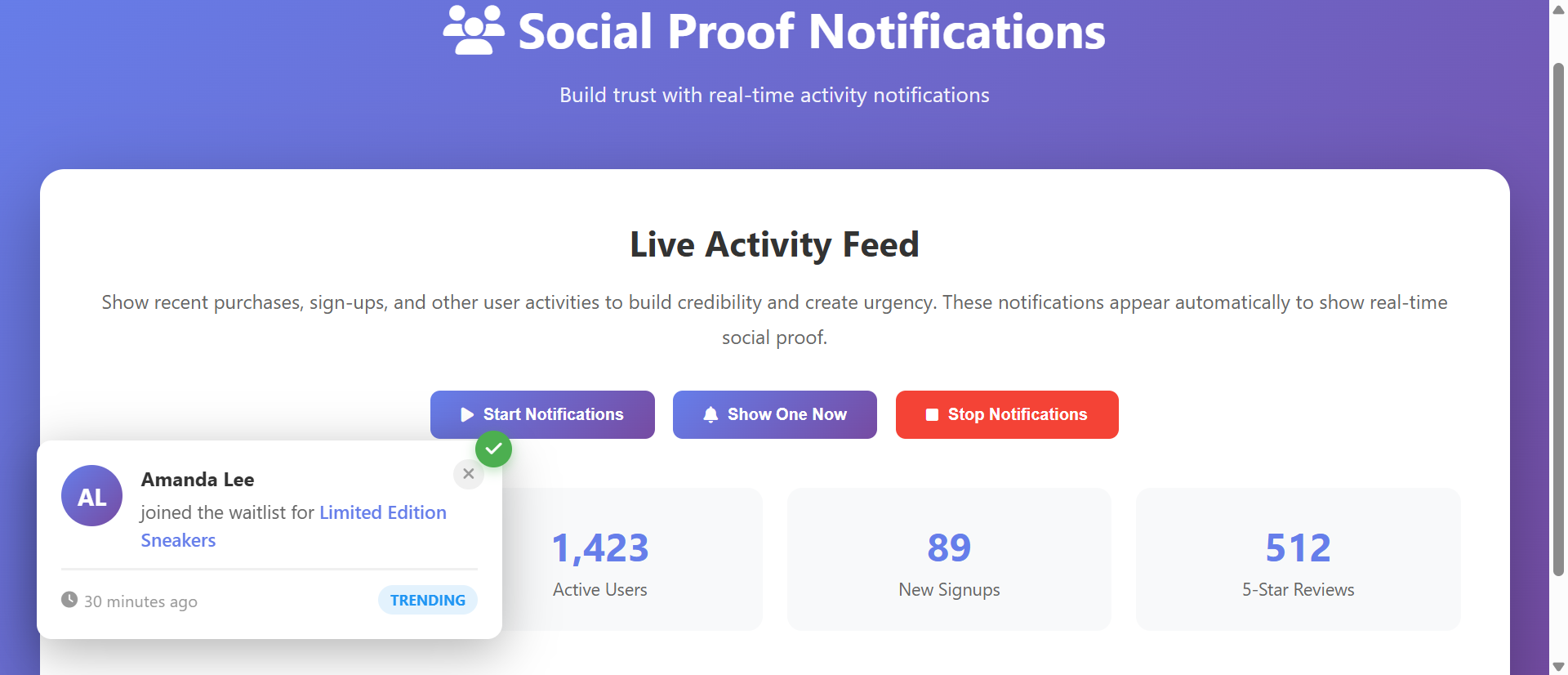
Live notifications displaying recent customer actions—"Michael from Seattle just purchased Premium Plan" or "Emma enrolled in Advanced JavaScript 3 minutes ago"—provide concrete evidence of active user base. These notifications appear as non-intrusive pop-ups (typically bottom-left/right corner) remaining visible 4-8 seconds before fading. The specificity (name, location, timing) creates authenticity impossible with generic claims. Seeing steady stream of real actions builds cumulative trust through repetition: one notification interesting, five notifications convincing, dozen notifications overwhelming proof of popularity. The real-time nature proves current relevance, not just historical success.
2. Live Visitor Count and Concurrent Activity Indicators
Displaying current active users—"127 people currently viewing this course" or "34 shoppers browsing this category now"—creates urgency through implicit competition. The concurrent activity signals scarcity: limited inventory or limited seats create pressure when visitors realize others are simultaneously evaluating same opportunity. For service bookings, seeing "8 people viewing available time slots" drives faster scheduling decisions. The live count dynamic (numbers fluctuating as visitors join/leave) proves authenticity; static numbers appear fabricated. Visitor counts particularly effective for high-demand products, limited inventory items, or event/webinar registrations where seat availability matters.
3. Recent Activity Timelines and Velocity Indicators
Timeline displays showing activity frequency—"43 purchases in last 24 hours" or "892 downloads this week"—communicate popularity through volume and velocity. Unlike cumulative counts (potentially accumulated over years), recent activity windows prove current momentum. Velocity indicators like "Selling fast: 12 purchases in last hour" combine recency with urgency. Activity timelines can segment by visitor demographics: B2B SaaS showing "17 enterprise customers signed up this month" targets enterprise buyers specifically. The temporal framing creates narrative of growth and acceleration, implying increasing popularity and FOMO urgency.
4. Location-Based Social Proof for Geographic Relevance
Geographic notifications—"Someone from Boston just enrolled" when visitor is Boston-based, or "47 customers in California" for California visitors—create local social proof more compelling than distant validation. The geographic proximity triggers "people near me" psychology: local validation feels more relevant than international activity. For service businesses (contractors, consultants, local events), geographic concentration proves local market penetration. IP-based geolocation enables automatic location matching showing most relevant proof. The feature respects privacy through city/state level granularity rather than specific addresses while maintaining personalization impact.
5. Milestone and Achievement Notifications
Celebrating participation milestones—"Just reached 10,000 students!" or "500th customer this month just signed up"—creates bandwagon effect psychology where people want to join winning teams. Milestone notifications provide mental anchors for scale perception; "10,000 students" communicates established platform more effectively than vague "thousands of users" claim. Achievement displays can highlight specific metrics: "4.8 average rating from 2,340 reviews" combines social proof (many reviewers) with quality proof (high rating). Course completions ("287 students completed this course this month") prove not just enrollment but successful outcomes.
6. Verification and Credibility Badges
Dynamic verification notifications—"Verified purchase" badges on reviews, "Expert certification confirmed" on instructor profiles, or "Authentic customer" indicators—combat fake review skepticism by proving legitimacy. Integration with third-party verification services (Trustpilot, Google Reviews, Verified by Visa) adds authority impossible with self-claimed credentials. Real-time verification displays like "Payment secured by Stripe" or "SSL verified connection" appear during checkout reducing payment friction. Security badges particularly critical for unknown brands where visitors question transaction safety. The third-party verification provides objective credibility self-promotion can't achieve.
5 Industries Where Social Proof Notifications Increase Conversions
1. E-Commerce: Purchase Confidence Through Buyer Activity
Online retailers increased conversion 234% through purchase notification systems displaying recent buyer activity and concurrent product viewers. Fashion e-commerce showing "Sarah from Austin just purchased this dress in size M" notifications saw cart abandonment decrease 45% as shoppers gained confidence in sizing and quality through peer validation. Inventory scarcity notifications ("Only 3 left, 12 people viewing") created urgency driving 67% faster purchase decisions. Low-inventory products with high viewer counts showed 312% conversion improvement as competitive pressure overcame buying hesitation.
2. SaaS Platforms: Trial Signup Momentum Visualization
Software companies improved trial conversion 189% using real-time signup notifications and active user counters. B2B collaboration tools displaying "23 teams started trials today" built credibility with enterprise buyers questioning adoption rates. Feature-specific activity ("127 users created workflows this hour") proved practical utility beyond marketing claims. Geographic targeting showing "17 companies in your industry using this platform" created relevant social proof for industry-specific buyers. The transparency shortened sales cycles 34% as prospects arrived pre-convinced by visible momentum.
3. Online Education: Course Enrollment Social Validation
E-learning platforms increased course enrollment 267% through student activity notifications and completion indicators. Displaying "892 students enrolled this month" for popular courses created quality inference: high enrollment suggests valuable content. Recent activity timelines ("43 students active in course forums today") proved ongoing engagement rather than one-time consumption. Course completion notifications ("127 students finished this course this quarter") addressed completion rate concerns common in online education. The social validation particularly benefited new course launches lacking review history.
4. Booking and Reservations: Availability Urgency Creation
Hotels, restaurants, and appointment scheduling services improved booking rates 198% using concurrent viewer notifications and recent booking displays. Hotel booking showing "18 people viewing this room type, 3 booked today" created urgency for limited inventory. Restaurant reservations displaying "Only 2 tables left for 7pm, 8 people viewing available times" drove 23% faster booking decisions. Event ticketing with "347 tickets sold in last 24 hours" indicators increased early-bird sales as FOMO overcame price hesitation. The scarcity visualization transformed leisurely planning into urgent action.
5. Financial Services: Trust Building Through Adoption Proof
Fintech apps and investment platforms increased account creation 156% through user growth notifications and transaction activity indicators. Displaying "4,230 new accounts opened this month" built credibility for unknown financial brands requiring high trust thresholds. Investment platforms showing "$2.3M invested by users this week" proved real money commitment beyond marketing claims. Security verification badges ("Bank-level encryption, verified by [Authority]") combined with activity proof addressed dual concerns of safety and legitimacy. The transparency particularly benefited challenger brands competing against established financial institutions.
Leverage Activity for Conversion Growth
Discover how social proof notifications transform hidden engagement into visible trust signals that accelerate purchasing decisions.
Explore Social Proof Solutions →The Psychology Behind Social Proof Effectiveness
1. Social Validation and Informational Conformity
Psychological research on informational social influence shows humans use others' behavior to guide decisions under uncertainty. When visitors lack personal experience with product/service, observing others' positive actions (purchases, enrollments, usage) provides decision-making shortcut. The logic: "If many people choose this, it must be good—they know something I don't." This heuristic particularly powerful for unfamiliar brands or categories where visitors lack evaluation frameworks. Social proof notifications activate this conformity mechanism by making others' choices visible, reducing decision uncertainty through crowd wisdom validation.
2. FOMO and Scarcity Psychology
Fear of missing out (FOMO) combines loss aversion with social comparison: people fear losing opportunities others are accessing. Social proof notifications displaying concurrent viewers or recent activity trigger competitive urgency: "Others are benefiting now; delay means missing what they're gaining." This urgency particularly acute when notifications suggest limited availability: seeing "47 people viewing only 3 remaining items" activates loss aversion more intensely than simple scarcity messaging. The social comparison element (others competing for same resource) intensifies urgency beyond individual scarcity would create alone.
3. Bandwagon Effect and Social Identity
Bandwagon psychology describes tendency to adopt beliefs/behaviors increasing in popularity, driven by desire to belong to winning groups. Activity notifications showing growing adoption ("10,000th customer," "fastest-growing platform") create perception of momentum attracting further adoption. Humans are tribal; joining popular choices feels psychologically safer than contrarian decisions. The effect particularly strong for status-conscious categories (fashion, technology) where being part of popular movement carries social value. Seeing others embrace offering reduces perceived risk of making wrong choice.
4. Authority and Credibility Transfer
When social proof notifications reference credible sources—verified purchases, expert endorsements, institutional adoption—authority transfers from validator to offering. "127 healthcare professionals enrolled" carries more weight for medical course than "127 people enrolled" because professional context signals expertise validation. Geographic specificity creates local authority: "47 customers in your city" implies local market acceptance validating quality. The credibility transfer works because it aggregates many individual validations into cumulative proof more compelling than marketing claims.
5 Common Social Proof Implementation Mistakes
1. Fake Notifications Destroying All Credibility
Fabricated activity notifications—randomized names with impossible patterns (purchases every 30 seconds despite low traffic) or recycled notifications users recognize seeing repeatedly—devastate trust when discovered. Users testing notification authenticity by refreshing pages or comparing across sessions quickly identify fake patterns. The damage extends beyond immediate abandonment; discovered deception creates lasting brand damage as users share findings via reviews and social media. Implement only genuine activity notifications with slight delays preventing real-time user identification, never fabricated data. Authenticity requirements aren't optional; fake social proof worse than none.
2. Overwhelming Frequency Creating Annoyance
Excessive notification frequency—popups appearing every 15 seconds continuously—transforms persuasive proof into irritating distraction. Users tune out or develop negative associations with brand when notifications interrupt browsing repeatedly. The optimal frequency balances visibility with subtlety: 1-3 notifications per minute during active browsing, with intelligent timing avoiding interruption of critical actions (checkout process, form completion). Implement notification caps ensuring individual users don't see identical notification twice, and frequency throttling preventing simultaneous multiple notifications. Too much social proof creates opposite effect: skepticism about authenticity and annoyance driving abandonment.
3. Generic Notifications Lacking Specific Credibility
Vague notifications—"Someone just made a purchase"—lack specificity that creates authenticity. Effective notifications include relevant details: name (first name or first name + last initial), location (city/state), timing ("3 minutes ago"), and specific action ("purchased Premium Annual Plan"). The specificity paradoxically increases credibility despite less information (no full names/addresses) because it feels genuine rather than templated. Balance specificity with privacy: sufficient detail proving authenticity without compromising user confidentiality. Generic notifications appear fabricated; specific notifications with appropriate privacy boundaries build trust.
4. Poor Mobile Optimization Causing Overlap Issues
Desktop-designed notifications often fail on mobile: large popups blocking content, notifications overlapping critical buttons (checkout, navigation), or positioning causing accidental clicks. Mobile notifications require compact design, strategic positioning avoiding key interaction areas, and touch-friendly dismiss options. Test on actual mobile devices verifying notifications enhance rather than obstruct experience. Consider mobile-specific notification styles: subtle banner formats instead of desktop-style popups, or positioned notifications that don't interfere with thumb-zone navigation. Poor mobile implementation worse than omitting notifications; frustration overcomes any credibility benefit.
5. Ignoring Privacy Regulations and User Consent
GDPR, CCPA, and privacy regulations require careful handling of user data in social proof notifications. Displaying full names without consent, revealing location with precision enabling identification, or tracking users across sessions for notification personalization without permission creates legal liability. Implement privacy-compliant approaches: first names only or initials, city-level location granularity, anonymization delays preventing real-time identification, and clear opt-out mechanisms. Consult legal counsel ensuring notification implementation complies with applicable privacy laws. The compliance isn't just legal requirement; it's trust foundation that makes social proof credible.
Real-World Case Study: Online Course Platform Transformation
An online course marketplace with 1,200+ courses and 340 average daily enrollments displayed zero real-time activity indicators on course pages or homepage. The platform had robust user base—87,000 total students, 4.6 average course rating, 12,000+ active monthly learners—but none of this activity was visible to new visitors. Site appeared potentially inactive or low-traffic to unfamiliar prospects.
Analytics revealed concerning patterns. Cold traffic (paid ads, organic search from non-branded keywords) showed 68% bounce rate versus 34% for warm traffic (return visitors, branded search). Average time on site for cold traffic was 1.2 minutes—barely enough to scan one course page. Conversion from cold visitor to enrollment was 0.8%, far below 3.2% warm traffic conversion. Exit surveys found prospects questioning: "Is this platform active?" "Are courses current?" "Do people actually use this?"
The platform implemented comprehensive social proof notification system across three categories. Real-time enrollment notifications displayed recent student actions: "Jessica from Portland enrolled in Python Fundamentals 4 minutes ago" appearing bottom-right corner. Live activity counters showed concurrent viewers: "23 students currently viewing this course" and "127 active learners in course forums." Recent activity timelines highlighted momentum: "487 enrollments this week" and "34 students completed this course this month."
Implementation included privacy safeguards: first names only, city-level location, 3-minute minimum delay between action and notification display preventing user identification. Notification frequency capped at 2 per minute maximum, with intelligent timing avoiding checkout flow interruption. Mobile-optimized compact format with thumb-friendly dismiss. Geographic matching showed local activity preferentially when available.
Development cost $28,000 including system design, privacy compliance review, and A/B testing optimization. Launch deployed to 50% traffic initially for measurement.
Results measured over 6-month test period:
- Conversion increased 234% – Cold traffic enrollment rate jumped from 0.8% to 2.7%
- Bounce rate decreased 43% – Cold traffic bounce dropped from 68% to 39%
- Time on site increased 292% – Average cold traffic session grew from 1.2 to 4.7 minutes
- Course page views up 178% – Visitors explored more courses after seeing activity proof
- Mobile conversion increased 312% – Mobile enrollment particularly benefited from activity visibility
Qualitative feedback transformed. Before: "Couldn't tell if platform was active or good quality." After: "Seeing hundreds of recent enrollments gave me confidence to try it." Exit survey questions about platform legitimacy dropped from 34% to 6% of responses.
Sales data showed notification-influenced behavior patterns. High-enrollment courses with frequent notifications converted 67% better than equivalent-quality low-enrollment courses with fewer notifications, proving social proof impact beyond inherent quality. Notifications mentioning local enrollments converted 89% better than distant locations, validating geographic matching. Peak activity hours (when more notifications displayed) showed 43% higher conversion than quiet hours despite identical course offerings.
Six-month impact: Social proof notifications generated estimated 3,840 incremental enrollments worth $1.47M revenue (average $383 course price). The $28,000 investment delivered 5,250% ROI. Beyond direct revenue, reduced bounce rate decreased customer acquisition cost 34% as more paid traffic converted, improving overall marketing efficiency.
Platform director reflected: "We had tremendous activity—hundreds of daily enrollments, thousands of active learners. But it was invisible. Social proof notifications transformed our biggest asset—real user engagement—into our most powerful marketing tool. Trust went from obstacle to advantage overnight."
5 Metrics That Prove Social Proof Notification ROI
1. Conversion Rate Improvement by Traffic Source
Track conversion rates segmented by traffic source (cold vs. warm, paid vs. organic, direct vs. referral) before and after social proof implementation. Effective notifications should show larger improvement for cold traffic (40-80% lift) versus warm traffic (15-30% lift) since unfamiliar visitors benefit most from trust-building. Compare notification-enabled pages versus control pages using A/B testing. Monitor conversion velocity—time from landing to conversion—which should decrease as social proof accelerates decision confidence.
2. Bounce Rate and Engagement Duration
Measure bounce rate and average session duration for landing pages with versus without social proof notifications. Effective implementation should reduce bounce 25-45% and increase time on site 40-80% as visitors explore confidently rather than abandoning skeptically. Track scroll depth and pages per session indicating increased engagement. Segment by device; mobile users often show larger engagement improvements from social proof visibility that reduces "is this legitimate?" uncertainty on unfamiliar small screens.
3. Notification Interaction and Influence Rate
Track what percentage of converters saw notifications before converting, and timing between notification view and conversion. High-performing notifications show 60-80% of conversions occurred within 10 minutes of viewing notification, indicating direct influence. Monitor click-through rates on clickable notifications and correlation between notification frequency exposure and conversion probability. Users seeing 5+ notifications convert 2-3x higher than those seeing 0-1, proving cumulative trust building.
4. Social Proof-Attributed Revenue Growth
Calculate incremental revenue from conversion rate improvement directly attributable to social proof using A/B test control group comparison. Track revenue per visitor improvement and customer lifetime value of notification-influenced customers versus control group. Monitor average order value; social proof often increases AOV as confidence enables larger commitments. Segment by product/service type identifying which offerings benefit most from social validation for optimization focus.
5. Trust and Credibility Perception Survey Data
Survey new customers asking about trust factors influencing their decision, specifically prompting about activity visibility and social proof. Track brand trust scores and "professional appearance" ratings before/after implementation. Exit surveys for non-converters should show decreased concerns about legitimacy/activity. Net Promoter Score often improves as social proof attracts better-fit customers already pre-validated by peer activity. Qualitative feedback reveals specific language around reduced risk perception and increased confidence.
The Future of Social Proof Notification Innovation
Emerging capabilities include AI-personalized social proof that analyzes visitor profile and displays most relevant activity: B2B visitors see enterprise customer notifications, specific industries see same-industry adoption, geographic matching shows local activity. Machine learning identifies which notification types (purchase, signup, usage, completion) most influence each visitor segment, dynamically optimizing displays for maximum conversion impact.
Video-based social proof notifications will show 5-10 second video clips of real customer testimonials or product usage instead of text notifications. "Watch Sarah explain why she chose Premium Plan" with authentic customer video creates emotional connection text can't achieve. Video authenticity combats fake notification skepticism while delivering richer social validation.
Blockchain-verified social proof will cryptographically prove notification authenticity, addressing rising skepticism about fabricated activity. Blockchain timestamps and verification allow prospects to independently verify claimed activity, restoring credibility in markets where fake social proof has created industry-wide distrust. The transparency premium justifies implementation cost for high-trust categories like financial services.
Augmented reality social proof overlays will let mobile users point cameras at physical retail locations seeing AR-displayed recent purchase activity, reviews, and popularity indicators. Physical stores gain online-style social proof transparency; customers shopping in-person access digital validation previously available only online. The convergence of physical and digital social proof creates omnichannel trust experience.
The social proof evolution points toward verified, personalized, multi-format validation systems that adapt to individual prospect needs while maintaining authentic transparency that builds rather than manipulates trust.
Implementation Checklist: Social Proof Notification Best Practices
- Use only genuine activity data—never fabricate notifications; implement slight delays preventing real-time user identification while maintaining authenticity
- Balance specificity with privacy using first names only, city-level location, and delayed display meeting GDPR/CCPA requirements
- Optimize notification frequency to 1-3 per minute maximum, preventing overwhelming repetition that creates annoyance
- Implement geographic matching showing local activity preferentially when visitor location known, creating relevant social proof
- Design mobile-first notifications with compact format, strategic positioning avoiding interaction zones, touch-friendly dismiss
- Create notification variety mixing purchase, signup, usage, and completion types preventing monotonous repetition
- Add timing specificity including "3 minutes ago" or "today" references proving recent relevance versus historical data
- Implement intelligent display rules avoiding notifications during checkout, form completion, or other critical user flows
- Build credibility through detail including specific actions ("purchased Premium Annual Plan" not "made purchase") creating authenticity
- Enable user control with dismiss options and frequency caps ensuring individual users don't see repeated identical notifications
- Track conversion attribution monitoring which notification types and frequencies drive highest conversion for optimization
- A/B test notification formats comparing popup vs. banner styles, positioning variations, and content specificity levels for optimal impact
Make Activity Your Competitive Advantage
Stop hiding engagement. Implement social proof notifications that transform invisible activity into visible trust-building momentum.
See Social Proof in Action →