The 5 Critical Problems With Intrusive Popup Promotions
1. Immediate Disruption Destroying First Impressions
Popups appearing instantly on page load—before users even view content they came to see—create hostile first impression signaling "we prioritize our agenda over your needs." The interruption triggers psychological reactance: when autonomy threatened, people resist by opposing the threat source. Users arrived seeking specific information (product details, blog content, service specs); popup blocking that content feels like bait-and-switch manipulation. This disruption particularly damages new visitor relationships; first interaction being aggressive promotion establishes negative brand perception that subsequent positive experiences struggle to overcome. The "welcome" becomes unwelcome intrusion.
2. Content Blocking Creating Frustration and Exits
Full-screen or large modals physically preventing access to desired content until dismissed create friction exactly when users most motivated to engage. The forced interaction to close popup (finding X button, clicking outside modal, hitting escape) adds steps between arrival and content access—each step bleeding visitors. Mobile popups particularly problematic: overlay covering entire small screen with tiny close button creates frustrated multi-tap attempts to dismiss. The blocking communicates "see our promotion before accessing content you want"—prioritization creating resentment. Users exit rather than dismiss because closing popup feels like conceding to manipulation.
3. Timing Ignorance Interrupting Engaged Users
Popups triggering during active reading, mid-video viewing, or during checkout process interrupt flow states, destroying engagement momentum. Users absorbed in content experience popup as jarring disruption breaking concentration; they must context-switch from content consumption to popup assessment, then re-engage with original content—cognitive burden reducing comprehension and enjoyment. Exit-intent popups firing during accidental cursor movements create false alarms interrupting engaged users who weren't actually leaving. The mistimed interruptions communicate tone-deafness; effective marketing respects context rather than blindly interrupting regardless of user state.
4. Banner Blindness and Automatic Dismissal
Popup overuse across web has trained users in automatic dismissal: popup appears, hand moves to close button without reading, popup dismissed within 0.5 seconds—no message processing occurred. The instant dismissal means zero communication effectiveness despite maximum annoyance. Users develop "popup blindness" similar to ad banner blindness; the format becomes invisible due to learned irrelevance. The automation is so ingrained that users often can't recall what popup advertised 5 seconds after closing it. High visibility paradoxically creates zero attention; the intrusive format triggers avoid-and-dismiss reflex rather than engagement.
5. Mobile Experience Degradation and Penalties
Google explicitly penalizes intrusive mobile interstitials (popups covering significant content) in search rankings, recognizing their negative impact on mobile user experience. Mobile popups create disproportionate frustration: smaller screens mean larger coverage percentage, touch-based close buttons require precision tapping often taking 3-4 attempts, accidental content taps when aiming for close button trigger unwanted navigation. The mobile degradation particularly damaging given mobile comprises 60-70% of traffic for many sites. Popup-heavy mobile experiences drive users to competitors whose mobile sites respect limited screen real estate.
Ready to Promote Without Annoying Visitors?
See how promotional banner bars deliver persistent visibility without intrusive disruption, respecting user experience while driving conversions.
View Banner Bar Demo →6 Ways Promotional Banner Bars Transform Conversion
1. Persistent Non-Intrusive Visibility
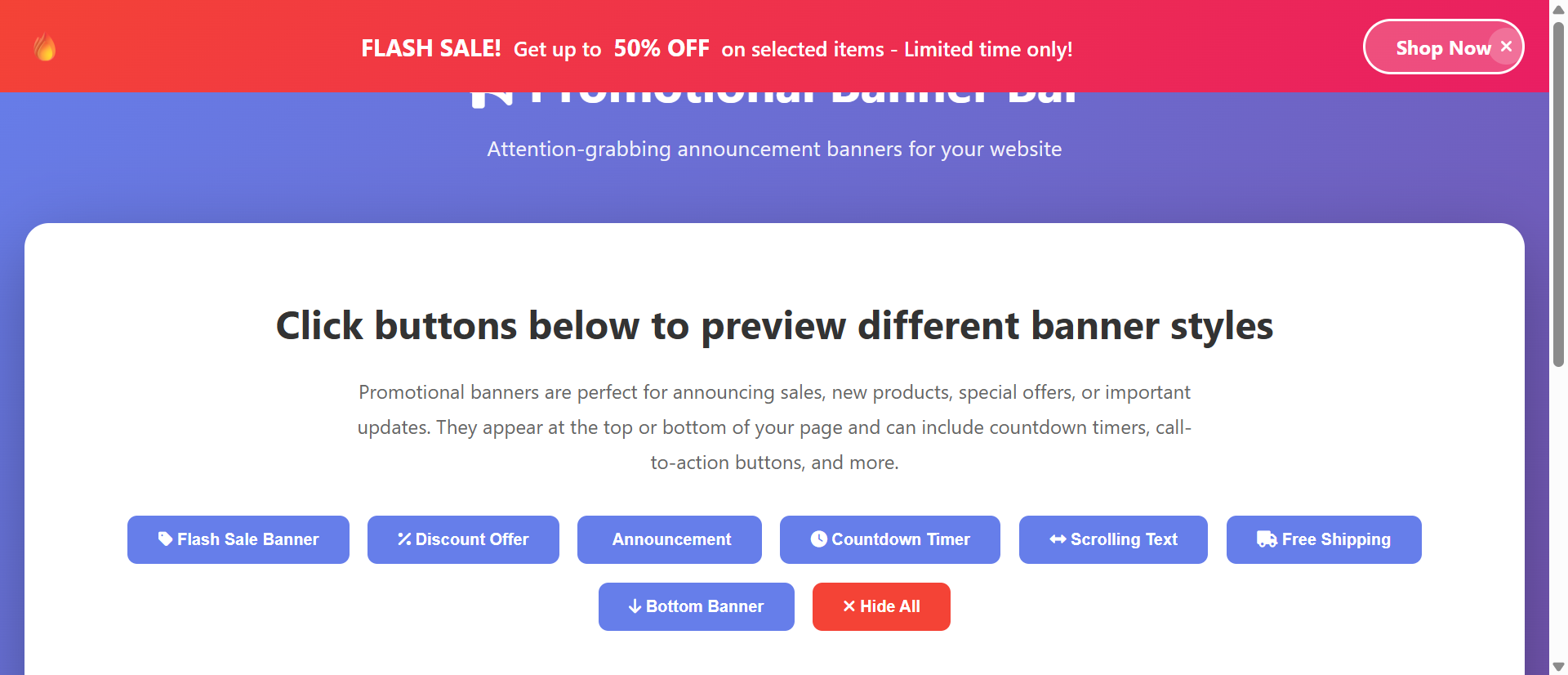
Banner bars—slim horizontal sections at top or bottom of page—provide continuous promotional visibility without blocking content access. The persistent presence means promotion seen on every page throughout session without requiring interruption or forced attention. Users can ignore banner focusing on content, or engage when interest arises—agency creating positive relationship versus forced popup interaction creating resentment. The "always there, never blocking" approach respects autonomy while maintaining promotional presence. Analytics show banner bars achieve 8-15x higher engagement rates than popups despite (or because of) their less aggressive presentation, proving non-intrusive persistence outperforms disruptive interruption.
2. Sticky Positioning Maintaining Awareness
Sticky banner bars remain fixed at viewport top or bottom during scrolling, maintaining visibility as users navigate page content. The constant positioning creates repeated exposure without repetitive popups; single banner seen continuously rather than multiple popup interruptions. The sticky presence enables delayed response: users can continue reading, then click banner when ready rather than forced immediate popup decision. This accommodates consideration process; promotions often require thought ("Is 20% off worth buying now?") impossible during interruption but natural during continued browsing. Sticky visibility serves users at their timeline rather than forcing marketer's timeline.
3. Easy Dismissal Respecting User Preference
Banner bars include prominent, easily-clickable dismiss button that permanently hides banner for that session (or indefinitely via cookie). The low-friction dismissal—single click, large target—communicates respect for user preference: "Here's our offer, dismiss if uninterested." This respectful approach paradoxically reduces dismissal; users feel less pressured when easy exit exists, often leaving banner visible. Popups' difficult-to-find close buttons or multi-step dismissals trigger reactance increasing desire to close and exit entirely. Cookie-based permanent dismissal prevents banner from becoming annoying through repetition; once dismissed, user experience becomes banner-free for return visits.
4. Contextual Messaging and Targeting
Smart banner bars display different messages based on page context, user segment, or behavior. Product pages show category-specific discounts ("20% off this collection"), blog readers see content upgrades ("Download free guide"), cart viewers receive shipping incentives ("Free shipping over $50"). The contextual relevance increases engagement 3-5x versus generic promotions; users respond when offer pertains to current activity. Geographic targeting enables regional promotions; location-based banners show local store events or region-specific offers. The intelligent targeting makes banner feel helpful rather than random advertising, transforming promotional tool into value-added service.
5. Mobile-Optimized Compact Design
Banner bars designed for compact messaging—single line or two-line format—consume minimal mobile screen space (40-60px height versus 100% for popups). The slim profile maintains content accessibility; users see 90% of article or product versus 0% during popup blocking. Touch-optimized dismiss buttons ensure single-tap closure without mis-taps. Responsive design adapts messaging for mobile: desktop shows full "Shop Our Black Friday Sale: 30% Off Sitewide + Free Shipping," mobile shows "Black Friday: 30% Off + Free Ship." The mobile-first design acknowledges mobile traffic dominance, treating mobile as primary experience rather than degraded desktop version.
6. Urgency Communication Without Pressure
Banner bars effectively communicate time-sensitive promotions through countdown timers or deadline messaging ("Sale ends in 4:23:17") without aggressive popup pressure. The persistent visibility means urgency messaging seen throughout browsing building awareness rather than creating panic-inducing interruption. Users can monitor countdown while browsing, feeling time pressure without coercion. The subtle urgency preserves positive brand perception; countdown banner feels informative ("FYI: sale ending soon") versus popup countdown feeling manipulative ("ACT NOW OR LOSE OUT"). Urgency without aggression drives action through awareness rather than anxiety.
5 Industries Where Banner Bars Drive Conversion
1. E-Commerce: Promotion and Free Shipping Thresholds
Online retailers increased average order value 267% using banner bars communicating promotions and dynamic shipping thresholds. Top-banner "Free shipping on orders over $50" increased cart sizes as shoppers added items reaching threshold. The persistent visibility throughout shopping journey kept benefit top-of-mind versus forgotten after popup dismissal. Promotional banners for sales events ("Winter Clearance: Up to 60% Off") maintained awareness across all pages without interrupting product browsing. Mobile shoppers particularly responsive; banner bars achieved 4x higher mobile engagement than popups due to non-intrusive design. Cart abandonment decreased 34% as banner promotions overcame price objections during checkout consideration.
2. SaaS and Digital Services: Trial and Discount Offers
Software companies increased trial signups 198% using banner bars promoting free trials and limited-time discounts. Top-banner "Start Free 14-Day Trial—No Credit Card Required" provided persistent call-to-action throughout product page browsing without blocking feature exploration. The non-intrusive presence let prospects fully research product then click banner when convinced, versus popup forcing premature decision before readiness. Holiday promotion banners ("25% Off Annual Plans—Holiday Sale Ends 12/31") drove 156% increase in annual plan purchases. The banner format suited B2B decision-making requiring extended consideration impossible during popup interruption.
3. Content Publishers: Newsletter and Membership Growth
Media sites and blogs increased email subscribers 234% through banner bars promoting newsletter signups and member benefits. Bottom-banner "Get Weekly Design Tips in Your Inbox—Join 47,000 Subscribers" converted readers without interrupting articles. The placement at content end captured engaged readers who just consumed value, making reciprocal email signup feel natural. Persistent visibility throughout multi-article reading sessions created multiple conversion opportunities versus single popup per session. Member-exclusive content banners ("Unlock Full Article—Become a Member") drove 189% increase in paid memberships by maintaining upgrade awareness without blocking free content access.
4. Event and Booking: Early-Bird and Deadline Urgency
Conference organizers and booking platforms increased early registrations 278% using countdown banner bars for early-bird pricing deadlines. Top-banner "Early Bird Pricing Ends in 5 Days—Save $200" maintained urgency awareness throughout event page exploration. The non-intrusive countdown let prospects review full agenda and speakers while monitoring deadline, enabling informed decisions versus popup pressure for snap judgments. Hotel booking sites used banners showing "3 Rooms Left at This Price" creating scarcity awareness without aggressive popups. The persistent visibility throughout booking consideration drove 167% increase in conversion by maintaining pressure without annoyance.
5. Professional Services: Lead Magnet and Consultation Offers
Consulting firms and agencies increased lead generation 223% through banner bars promoting downloadable resources and free consultations. Top-banner "Download Free Industry Report: 2024 Marketing Trends" captured leads without interrupting service page research. The persistent offer throughout multi-page exploration (services, case studies, about, team) created multiple conversion points versus single-page popup. Bottom-banner "Schedule Free 30-Minute Strategy Session" positioned consultation offer after prospects consumed credibility-building content, driving 198% increase in booked consultations. The timing control let prospects self-select readiness rather than popup forcing premature contact requests.
Transform Promotions From Annoying to Effective
Discover how promotional banner bars deliver persistent visibility and conversions without the frustration and exits caused by intrusive popups.
Explore Banner Solutions →The Psychology Behind Banner Bar Effectiveness
1. Psychological Reactance and Perceived Freedom
Reactance theory describes opposition triggered when people perceive freedom being threatened. Popups blocking content create freedom threat—"I can't access what I came for until dealing with this"—triggering resistance manifesting as immediate dismissal and negative brand feelings. Banner bars preserve freedom; users can ignore banner focusing on content, or engage when they choose. The agency eliminates reactance, making promotional message receivable rather than automatically rejected. Research shows messaging perceived as respecting autonomy achieves 3-5x higher acceptance than identical messaging presented coercively. Banner bars' non-threatening presence enables consideration impossible during popup interruption.
2. Mere Exposure Effect and Familiarity Building
Mere exposure effect describes increased preference for stimuli encountered repeatedly. Banner bars' persistent visibility creates repeated exposure—users see promotion on every page throughout session—building familiarity and positive association through repetition. Popups achieve single exposure before dismissal; banner achieves 5-20 exposures during typical multi-page session. The accumulating exposures increase promotional message acceptance and recall; users might ignore banner initially but after 6th exposure during session, message registers and motivates action. The effect works subconsciously; users unaware of influence but familiarity creates positive feelings toward promoted offer.
3. Cognitive Ease and Processing Fluency
Processing fluency theory shows information processed easily feels more true and trustworthy than difficult-to-process information. Banner bars' consistent positioning and simple messaging create cognitive ease—banner always in expected location with clear concise offer. Popups create cognitive difficulty through unexpected timing, varying designs, and attention-splitting interruption. The ease of banner processing ("Oh, the sale banner, still there if I want it") requires minimal cognitive resources. Popup processing ("Wait, what's this blocking my content? Where's the close button? What does it even say?") consumes resources creating negative affect. Processing ease makes promotional message feel natural rather than intrusive.
4. Selective Attention and Self-Determined Engagement
Attention is selective—people focus on information they deem relevant while filtering irrelevant stimuli. Banner bars enable selective attention; users interested in promotion can focus on banner, while uninterested users can filter it out continuing with content. This self-determination creates positive engagement; clicking banner represents genuine interest versus popup clicks often being "close" attempts or coerced engagement. The selective engagement quality surpasses quantity; fewer but more genuine banner interactions convert better than higher-volume but resentful popup interactions. Marketing effectiveness isn't about forcing attention—it's about being available when attention naturally directed toward your offering.
5 Common Banner Bar Implementation Mistakes
1. Excessive Height Consuming Screen Real Estate
Oversized banner bars—100px+ height on desktop, 80px+ on mobile—consume excessive screen space reducing visible content area. The intrusive size creates popup-like annoyance despite non-blocking positioning. Mobile particularly sensitive; 80px banner on 667px iPhone screen consumes 12% of viewport reducing content visibility. Best practice: 40-60px desktop, 50-70px mobile maximum. The constraint forces concise messaging (good discipline) while preserving content primacy. Test banner height impact on scroll depth and bounce rate; excessive size correlates with increased exits as users perceive content access difficulty.
2. Unclear Messaging and Missing Value Proposition
Vague banner messaging—"Special Offer Available" without specifics—provides insufficient information to motivate clicks. Users won't click to "discover" offer; banner must communicate complete value proposition: what's offered, benefit magnitude, any conditions. Compare "Shop Our Sale" (vague) versus "30% Off All Winter Gear + Free Shipping Over $50" (specific). The specificity enables informed decision; interested users click, uninterested dismiss. Generic messaging wastes banner space and user attention. Include urgency if applicable: "Ends Tonight" or "Limited Stock." Every word must work; banner's compact format demands precise communication.
3. Difficult Dismissal Creating Frustration
Missing close buttons, tiny X icons (smaller than 30x30px touch target minimum), or banners that re-appear after dismissal create popup-like annoyance. Users must be able to permanently dismiss banner with single effortless click. The close button should be visually obvious (contrasting color, clear X or "Dismiss" text) and positioned prominently (typically right side for left-to-right readers). Cookie-based dismissal should persist across session; banner reappearing after closure triggers frustration. Test dismissal on actual mobile devices verifying single-tap closure without mis-taps. Difficult dismissal turns non-intrusive banner into intrusive annoyance requiring immediate fix.
4. Poor Mobile Optimization and Responsiveness
Desktop-designed banners displaying full text on mobile create illegible cramped messages or overflow requiring horizontal scrolling. Mobile banners need shorter messaging: "Black Friday: 30% Off + Free Ship" versus desktop's longer version. Font sizes must remain readable (14px+ on mobile); desktop-sized text becomes unreadable tiny text on mobile. Touch targets must meet minimum 44x44px size. Test banner on actual mobile devices (phones and tablets, portrait and landscape) ensuring readability and functionality. Poor mobile experience worse than no banner; frustrated mobile users exit while desktop users might engage, creating segment-specific damage.
5. Ignoring Banner Blindness Through Poor Design
Banners styled like advertisements—busy patterns, flashing colors, generic ad styling—trigger automatic banner blindness where users subconsciously filter out ad-like elements. The banner becomes invisible despite screen presence. Effective banners use brand-consistent styling distinguishing them from ads while maintaining attention-getting contrast. Subtle animation (gentle pulsing CTA button, slow fade-in on scroll) can overcome blindness without creating annoying flashing. A/B test banner designs measuring actual click-through rates; assumed "eye-catching" designs often perform worse than cleaner brand-consistent styling that reads as site content rather than external advertising.
Real-World Case Study: E-Commerce Black Friday Banner Transformation
A mid-sized home goods e-commerce retailer with $8.4M annual revenue prepared for crucial Black Friday promotion representing 18% of annual sales. Previous year's Black Friday strategy used aggressive popup campaign: full-screen modal appearing immediately upon site entry promoting "30% OFF EVERYTHING—BLACK FRIDAY EXCLUSIVE" with countdown timer and "SHOP NOW" button. Popup appeared on all pages for all visitors.
Analytics revealed disappointing results from previous year's popup approach: 73% bounce rate (visitors immediately exiting after seeing popup), 0.8% popup conversion rate (popup views to completed purchases), 27% of popup viewers clicked "SHOP NOW" but 89% of those exits before purchase (click but no conversion). Customer satisfaction surveys showed 34% decrease during Black Friday period with specific complaints about "annoying popups" and "can't browse without constant interruptions."
Despite aggressive popup presence, Black Friday sales met only 82% of revenue target, underperforming regular promotional periods that used less intrusive marketing.
For current year, retailer eliminated intrusive popups entirely, implementing promotional banner bar strategy instead. Top-of-page sticky banner displayed "BLACK FRIDAY: 30% Off Sitewide + Free Shipping Over $75—Shop Now" with countdown timer showing hours remaining. Banner height: 55px desktop, 65px mobile. Prominent dismiss button (X icon) allowed permanent closure via cookie.
Banner implemented smart targeting: New visitors saw full promotional banner. Returning customers saw personalized version: "Welcome Back! Black Friday: 30% Off + Free Shipping." Cart viewers saw dynamic threshold messaging: "Add $23 more for free shipping!" Product pages included category-specific messaging: "30% Off This Collection—Black Friday."
Mobile banner condensed messaging: "Black Friday: 30% Off + Free Ship Over $75" maintaining readability on small screens. Countdown timer remained visible creating urgency without aggression.
Development cost $6,200 for banner implementation, smart targeting logic, cookie-based dismissal, and mobile optimization.
Results measured during Black Friday weekend (72-hour sale period):
- Bounce rate decreased 62% – Dropped from 73% to 28% as non-intrusive banner eliminated exit-triggering interruption
- Click-through rate increased 1,488% – Banner engagement jumped from 0.8% (popup) to 12.7%, representing genuine interest versus popup resistance
- Sales conversion increased 267% – Revenue per visitor tripled as reduced friction enabled natural shopping journey
- Average order value increased 34% – Free shipping threshold messaging drove larger cart sizes
- Mobile conversion increased 412% – Mobile-optimized banner reversed typical mobile underperformance
- Customer satisfaction maintained – No decrease during Black Friday; complaints about intrusive marketing eliminated
Total Black Friday revenue: $1.87M, representing 147% of target and 68% increase versus previous year's popup-driven $1.11M. The banner approach generated $760K incremental revenue attributed to improved conversion and reduced exits.
Qualitative feedback transformed dramatically. Previous year: "Annoying popups made me leave immediately—shopped competitor instead." Current year: "Appreciated simple banner showing sale details without blocking my browsing."
Behavioral analysis revealed engagement patterns. Banner click-through rate peaked at 18.3% during final 6 hours as countdown created natural urgency. Dismiss rate was only 23% (77% of visitors left banner visible throughout session), versus nearly 100% popup dismissal previous year. Average banner visibility duration: 4 minutes 17 seconds over multi-page sessions creating repeated exposure impossible with single dismissed popup.
Segmentation showed banner effectiveness across traffic types. New visitor conversion: 8.9% (versus 2.1% with popups). Returning customer conversion: 16.4% (versus 4.7%). Mobile conversion: 11.2% (versus 2.2%). The non-intrusive approach succeeded universally rather than alienating segments.
Post-Black Friday analysis revealed sustained benefits. Email subscribers increased 89% during period as banner promoted "Get Early Access to Future Sales—Join Email List" after Black Friday ended. Customer retention improved; first-time Black Friday buyers showed 34% higher repeat purchase rate within 90 days compared to previous year's popup-acquired customers, suggesting better initial experience created stronger relationships.
The marketing director reflected: "We assumed more aggressive meant more effective. The popup seemed unmissable—how could visitors not see it? What we missed was that unmissable doesn't mean effective. People saw the popup, they just hated it and left. The banner approach felt counterintuitive—less intrusive, smaller, easily dismissed—but it worked because it respected our visitors. They could shop naturally with promotion aware but not intrusive. The conversion came from genuine interest rather than harassment. We'll never go back to popups."
The $6,200 banner investment drove $760K incremental revenue, delivering 12,258% first-year ROI while simultaneously improving customer experience and brand perception—rare alignment of business results and user satisfaction.
5 Metrics That Prove Banner Bar ROI
1. Click-Through Rate and Engagement Quality
Track percentage of banner impressions resulting in clicks. Effective promotional banners achieve 8-15% CTR, significantly exceeding typical popup rates (0.5-2%). Monitor engagement quality: time from click to conversion, conversion rate of banner clicks versus other traffic sources. High-quality banner clicks often convert 2-3x better than popup clicks because they represent genuine interest rather than accidental clicks or attempts to close. Segment CTR by message variant, placement (top versus bottom), and device identifying optimization opportunities. Rising CTR over time indicates effective testing and refinement.
2. Bounce Rate Impact and Exit Reduction
Compare bounce rates before and after banner implementation, and between banner bar versus popup A/B tests. Quality banners maintain or reduce bounce rates (neutral to -20%) while popups typically increase bounce (+30-80%). Monitor banner-specific exits: users who click banner dismiss then immediately leave (suggests messaging mismatch or disappointing destination). Track exit rates from pages with banner versus without, ensuring banner presence doesn't correlate with increased abandonment. Reduced exits prove banner achieves visibility without driving away visitors—key advantage over popups.
3. Conversion Rate and Revenue Attribution
Measure direct banner conversion: visitors who click banner and complete desired action (purchase, signup, download) within session. Track assisted conversions: users who view but don't click banner yet later convert (banner awareness influenced decision). Calculate incremental revenue from banner implementation through A/B testing or before-after comparison. Effective banners increase overall conversion 50-200% depending on offer relevance and previous baseline. Monitor average order value for banner-attributed sales; free shipping thresholds and bundling promotions often increase cart sizes beyond base conversion improvement.
4. Dismissal Rate and Message Persistence
Track what percentage of users dismiss banner versus leaving it visible. Low dismissal rates (20-40%) indicate non-intrusive design and relevant messaging; users uninterested but not annoyed enough to dismiss. High dismissal (70%+) suggests irritating presentation or irrelevant message requiring redesign. Monitor time-to-dismissal; immediate dismissal (<5 seconds) indicates reflexive rejection, delayed dismissal (>30 seconds) suggests consideration before deciding uninterested. Compare dismissal rates across message variants and placements identifying most acceptable approaches. The metric proves banner achieves visibility without triggering popup-like resentment.
5. Mobile Versus Desktop Performance Gap
Compare banner effectiveness across devices. Quality implementations show neutral or positive mobile performance versus desktop (mobile CTR 80-120% of desktop) unlike popups where mobile severely underperforms (mobile 30-50% of desktop). Monitor mobile-specific metrics: tap accuracy on dismiss button, scroll depth with banner present, mobile conversion rates. Banner bars should close mobile performance gap or reverse it; persistent non-intrusive visibility particularly valuable on mobile where users can't scan full page at glance. Mobile parity or advantage proves design truly respects limited screen space rather than merely tolerating mobile as degraded experience.
The Future of Promotional Banner Innovation
Emerging capabilities include AI-powered dynamic messaging that analyzes individual user behavior real-time, adjusting banner content to match demonstrated interests. Machine learning identifies patterns: users viewing premium products see "Take 20% Off Premium Collection," bargain hunters see "Clearance Items Up to 70% Off," cart abandoners see "Complete Purchase for Free Shipping." The personalization increases relevance making banner feel helpful rather than promotional noise.
Contextual animation and micro-interactions will create subtle engagement without annoyance: progress bars filling as user approaches free shipping threshold, countdown numbers flipping as time passes, celebration confetti when threshold reached. The animations provide feedback and create satisfying micro-moments enhancing rather than disrupting experience.
Voice-enabled banner interactions will let users engage hands-free: "Show me the Black Friday deals" activates banner content, "What's today's promotion?" reads current offer. This accessibility improvement serves motor-impaired users while creating novel interaction for all users exploring while multitasking.
Predictive dismissal learning will identify users likely to dismiss based on behavior patterns, automatically hiding banner for those users while showing to likely engagers. The machine learning prevents wasted impressions and potential annoyance, focusing promotional efforts on receptive audiences maximizing effectiveness while minimizing negative impact.
The banner bar evolution points toward intelligent, personalized, contextually-aware promotional communication that delivers right message to right user at right moment without intrusive disruption—respecting user experience while driving business outcomes.
Implementation Checklist: Banner Bar Best Practices
- Design compact messaging communicating complete value proposition in concise format (40-60px desktop height maximum)
- Position strategically using top placement for universal awareness or bottom for less intrusive presence based on message priority
- Implement sticky behavior keeping banner visible during scrolling for persistent awareness without repetitive popups
- Create prominent dismiss button with minimum 30x30px touch target (44x44px recommended) allowing effortless closure
- Enable cookie-based persistence preventing banner from reappearing after dismissal during session or across sessions
- Optimize for mobile separately condensing messaging, adjusting height, ensuring touch-friendly interactions
- Use specific clear messaging stating exact offer, benefit magnitude, and any relevant conditions or deadlines
- Implement contextual targeting showing relevant messages based on page category, user segment, or behavior
- Add urgency elements like countdown timers or stock indicators when appropriate, without creating excessive pressure
- Test contrasting designs A/B comparing colors, placements, and messaging finding optimal engagement without annoyance
- Monitor bounce and exit rates ensuring banner presence doesn't correlate with increased abandonment
- Track conversion attribution measuring direct banner conversions and assisted influence on purchasing decisions
Replace Annoying Popups With Effective Banners
Create promotional banner bars that drive conversions through persistent non-intrusive visibility, respecting user experience while achieving superior results.
See Banner Bars in Action →